23.4.25

Save Soil Interview

Sadhguru's Save Soil Article.

Interview with Matthew Ingram - Author of 'The Garden'

Apr 23, 2025

Save Soil was delighted to speak to Matthew Ingram about his fascinating new book, “The Garden: Visionary Growers and Farmers of the Counterculture”. The book explores the transformative journey of the 1970s countercultural farmers and growers whose radical practices redefined how we grow and eat today. He has interviewed Save Soil founder Sadhguru for the book, which is available online via Amazon.

In this fascinating interview, we discover his motivation for writing the book, and insights he gleaned into connections between soil, spirit and society.

 
Matthew, what inspired you to write the garden, and what was your motivation for getting started in this project?

Well, the previous book I wrote, called ‘Retreat’ was about health and counterculture, [exploring] the health modalities that happened in the hippie era. So things like macrobiotic food, transcendental meditation, LSD, psychiatry, those kinds of things. There’s a big dose of Eastern philosophy in that, and I ended up following the guy who coined the term ‘counterculture’ called Theodore Roszak. He went on to coin something called ‘Eco-Psychology’, which is a reasonably well known kind of discipline now, relating to health and well being and how that relates to the environment. I started reading into that, and then immediately I came across growing and farming. So it seemed like it was a natural route out from the health thing. 

The Garden is chronicling individuals, some of whom don’t come from farming backgrounds, but in some ways changed agriculture, or how many people see agriculture. Did you feel there was a core internal driver that was consistent across the people featured in your book?

It’s interesting, because almost all of the people that I talked to weren't from agricultural backgrounds, and they all got involved in it for philosophical reasons, or reasons of rebellion or spiritual reasons. It was quite unusual that, for instance, Patrick Holden (CBE, founder of the U.K. The Sustainable Food Trust and U.S. Sustainable Food Alliance), who I spoke to, became a follower of Gurdjieff (20th Century Mystic and Spiritual teacher born in Russia). Then someone like David Holmgren, who is the guy who coined the term ‘permaculture’ and the permaculture co-originator - he had psychedelic experiences that influenced him. Eliot Coleman (American farmer and proponent of organic farming) is another good example. He came at it through outdoor sports. He was an Olympic canoeist, whitewater rapid canoeist, and he was just interested in being in the outdoors. But there's this kind of underlying idea of health and well being, ecological well being and spiritual ideas were a common thread through all of them. I was thinking, that's great! 


Within those kinds of ideas, are there specific insights that helped frame the kind of narrative of the progress, or in particular that stood out to you, or inspired you?


Absolutely, there is something that's consistently picked up by even the founders of this kind of era or you might say movement, like Rudolf Steiner (Austrian social reformer and esotericist), Masanobu Fukuoka (Japanese farmer and philosopher), and someone like Lady Eve Balfour (British organic farmer and co-founder of the Soil Association). They're all coming to ideas, I would say, through Eastern philosophy of ‘holism’. So, thinking of ourselves and our actions as related to the environment and everything being interconnected. These are fundamental  ideas in Buddhism, the Vedas and Taoism. These ideas came from the east to west through conduits like Herman Hesse (German-Swiss poet and novelist) and the visiting gurus like Mahesh Maharishi Yogi and Prabhupada. And so that idea of holism, and it's something I know that Sadhguru talks about, when he says your pulmonary system is out there hanging on a tree, which is his way of expressing it. That has led people to think, well, what am I eating? How am I making my food? How can I do that in the sort of way that's dharmic, or that embodies right livelihood.

That's wonderful. In our context with Save Soil, Sadhguru relates soil degradation very much to both mental and physical well being. He says that one reason why we’re seeing a global mental health crisis is because we're not getting enough nutrients or micronutrients in our food.

That’s very true. Our environments are degraded. Wendell Berry, who's an interesting American writer, says that the growing alienation from farming as an activity has a root cause behind mental ill health, in the sense that people are not used to physical labor, and that therefore they're not as hardy emotionally.

Perhaps then moving on to a more practical question - a lot of the people in your book have very kind of powerful ideals, or approaches to farming. Are there particular practical hurdles that really stuck out to you that they were encountering when they were trying to manifest these ideals on the ground?

Great question. I mean, the one that immediately springs to mind is how the Hare Krishna movement have adapted dairy farming. People take it for granted in the West, they'll say, “I'm a vegetarian, but I have cheese and milk and butter” - obviously that necessitates killing male calves to make the cow lactate to produce milk. And so the Hare Krishna farms have developed - I think it's a traditional Indian way of doing it - but they brought over with them to the west very careful management of the relationship between the mother and the calves, so that you didn't have to kill a calf. So that's one example of how the spiritual ideas mapped onto a reality. Another very good one would be Masanobu Fukuoka, his Buddhist-influenced idea of ‘do nothing farming’ was actually quite a lot of hard work, his idea of do nothing farming, but implied not tilling and instead using mulches. So that was another practical idea that grew out of a philosophy.

Conventional farming is obviously very profit driven, and we could say success is measured by yield and profit. How did some of the counterculture figures and farmers that you were exploring define success? Was it perhaps more measured by biodiversity, or soil vitality, or community resilience - perhaps personal growth?

These are really, very genuinely interesting questions, and not put to me before. I think that there was an emphasis on self sufficiency. For instance, in something like The Farm in Tennessee (a large community of families and friends living on three square miles in southern middle Tennessee, founded on the principles of nonviolence and respect for the earth), which was this mega commune, the role of the farming was to feed the community. I think it was a 1500 strong population at some point, so it involved a massive amount of food farming. What came through organic pioneers - people like Elliot Coleman would see success is feeding their community. But success could also be defined as sustainability - so not destroying the soil, not taking everything out of it. This idea of the Sustainable Food Trust, which is Patrick Holden's brainchild is leaving the land in good health, having something to pass on, and not just stripping all its assets.

Patrick Holden spoke at one of our panel discussions at the Save Soil pavilion at COP 29. Really wonderful work. For the next question Matthew, beyond the kind of historical narrative that you explore throughout the book, how has researching and writing the garden personally impacted your own connection to food or the land or even spirituality?

Well, my previous book (Retreat) tracked what I describe as the ‘etheric counterculture’ - the use of psychedelic drugs and transcendental meditation - things were very much geared towards being “disintegrated”, in a sense. I think that in a way, the experience of writing that first book and subsequently of writing ‘The Garden’ matches the experience of that generation where they all went very far out, and needed to come back to earth. In 1969 there was this big movement back to the land, and in spiritual terms, it was all about grounding. It was about needing to get connected again, that they’ve been very abstract and etheric, and needed now to get integrated. And so I think that my journey through reading and researching and meeting these people followed that same course. I started gardening on my roof garden, and also visiting a lot of farms, spending time in the countryside. In a way my journey has been a journey of integration. That's why it's so interesting to read Sadhguru’s work, and to come across him, because although he frames himself within the very etheric Vedic tradition, he actually has a lot of currents in his thinking that are very integrated. So he's a very interesting figure for me.


There's such a breadth of different ideas and perspectives and origins of the kind of characters in the book. Do you think there was one particular method, figure, or practice that has come from the counterculture and made the large impact on how we see modern farming or food systems?

Yeah, well, the really dominant thing is permaculture. It's not widely appreciated that David Holmgren, who originated the idea with Bill Molison, was 100% counterculture. How I kind of summarize Permaculture is that it’s about ‘harmonizing efficiencies’. An example is saying, “we've got too many slugs here”. The classic permaculture answer to that is, instead, “you haven't got enough ducks”. The best example of it is - do it the way nature works. Especially how a forest works. Everything is in harmony, working together and feeding on each other's systems and efficiencies. It owes so much to indigenous thinking, but also to Buddhist ideas of holism. I don't think people realize how much that even the word ‘Permaculture’ relates to counterculture

Jumping topics slightly, counter culture is not usually associated with an abundance of resources or necessarily with profit. Obviously farms need resources, and to take a concept to a large scale does take a certain level of resource and visibility. In our context, Sadhguru talks a lot about marrying economy and ecology, and how important it is that ecological solutions need to be economically viable to scale them up. How did the individuals you were looking at for your book approach the economics of their operations, and was there a particular economic model that was pioneered that you found interesting?

One of the one of the things that characterized that era (the early to mid 70s), was that the economics of growing your own food were actually quite good. Then in the Reagan / Thatcher era in the West, a whole generation found they were swimming against the tide. It wasn't economic any more, and so that's why a lot of these communes went bust. But in terms of access to assets and energy, the interesting innovation that the counterculture bought was to put more hands on the land,. You can run a small plot of land, with more labor and closer  management, with a much higher yield than you would otherwise. The model of chemical agriculture is one individual with a lot of machinery and chemicals managing 1000s of acres. But actually, if you reverse that and have more hands on the land, more people essentially interested in agriculture as a profession that is valued, you could have a much greater productivity. 

Furthermore, when you start planting for biodiversity, as Vandana Shiva often remarks, if you have the traditional Indian farm system with all these hundreds of different crops, you actually have much higher yields than if you're just doing rice or wheat. A big reference point of the book is this guy called E F Schumacher (British Statistician and Economist), who wrote this idea of Buddhist economics, which was, again, that same principle of tweaking the understanding of ‘value’, thinking more about sustainability, thinking more about labor and those kinds of ideas.

You just mentioned ‘Buddhist economics’, which perhaps is very particular to certain geographies. In your research, what were the similarities or differences in how different geographies impacted how these sustainable farming movements?

Pretty much every single one of the farming setups that I covered had an individuality to it, and I think it related to geography. So for instance, Patrick Holden started growing vegetables in Wales, but progressively moved more and more to dairy, because of the Welsh climate. But then sometimes the challenges are different. With The Farm, they had terrible soil. So, you know, they pioneered using green manure on a really large scale. In fact, that was larger than, for instance, the Rodale Institute was doing it (a non-profit organization that supports research into organic farming). So it's very different for all of them.

In our own work, something we hear about often from different experts is the immense variety in soil type. Agricultural practices have to be so tailored to the local landscape.

One of the things that did come through, looking at all these different systems, was Albert Howard's (English botanist and founder of the organic farming movement) idea of the “Law of Return” - the idea of bringing organic matter back to the land, which actually works in almost all of those scenarios. So even if you talk to a chemical farmer, and I happen to know some farmers from Gloucestershire in the UK who are chemical farmers - even they will respond to this idea of bringing more organic matter back to the land. It's probably the strongest universal principle that I came across.

Beautiful, that very ties in with our work with Save Soil. Our core ask of policy makers is to help establish policies and prioritize returning organic matter to soil, and maintaining a minimum level of organic matter in agricultural soils.

Well, I mean, that's got to be the absolute most important thing, and I've always admired that in your messaging.

A final question for you on that note, if there was one message or experience you wanted to leave readers with when reading your book?

Because I live on Old Street, in the middle of the City of London in the UK, one of the things that is obvious to me, having done all this research, is how alienated people are from the countryside and the ways of agriculture and the ways in which food is made. So if there was one thing, it’s to try to wear down that rural urban divide, and to encourage people to eat organically, or eat biologically grown food, or maybe try gardening themselves. Just to get in the mindset of it. I grow vegetables like potatoes and cabbages - it's not meaningful in scale - but it is a symbolic gesture. Those kinds of things, a bit of gardening, eating biological food, if you're in the city, just establishes that connection and that understanding.

18.4.25

JADAM Sulphur

This is my third and final JADAM post. Beyond JADAM’s pesticide and JADAM Microorganism Solution the third preparation which has appealed to me is JADAM Sulphur. or JS for short. JS claims to be “Effective against black spot, pear rust, powdery mildew, downy mildew, etc.” That’s to say as an “organic” herbicide treating fungal problems.

I don’t get much of this but what I do get I don’t like. Naturally I am doing what I can to make sure the soil health is as good as I can make it in containers, and that always needs to be one’s first step, but I need a little more help with these plants.

A plant in a pot

AI-generated content may be incorrect.

Here for instance is something which starts to affect my tiny apple tree’s leaves in spring, and by the summer has devoured the entire plant.

A close up of a plant

AI-generated content may be incorrect.

And here is a problem which affects the Acers in the back yard.

A table with a few bottles of liquid and gloves

AI-generated content may be incorrect.

As you can see from Youngsang Cho’s video on YouTube the process of making JADAM Sulphur for oneself is a little bit fiddly and dangerous, but not prohibitively so.

It’s actually remarkable that one can perform the necessary chemistry at all. In the JADAM Organic Farming book Cho elaborates, “After nearly 100 experiments, I found the method to completely liquefy sulfur. I have still not forgotten the joy I felt that time. My small kitchen was my lab, it was around 3 a.m. that I knew I finally made it.” After further tweaks which meant that you didn’t need steel containers (the temperature gets very high) and the process could be done in plastic ones instead of immediately patenting his method Cho disclosed the knowledge.

However, in no circumstances will I need the 100 litres of concentrated JS that the recipe produces. Not even a fraction of that. To spray the plants I wanted I needed only 1 ml. That would be different if I had a market garden to deal with. So again, I used the JADAM concoction made by Dr Forest.

A bottle of liquid on a table

AI-generated content may be incorrect.

For one litre of solution (and this was 75cl) you need 10 ml of JWA.

A bottle of liquid on a table

AI-generated content may be incorrect.

I added to that 1 ml of Liquid Sulphur.

A person spraying a plant

AI-generated content may be incorrect.A person spraying a plant

AI-generated content may be incorrect.

And sprayed it on my Japanese Maple and Amelanchier.

A person spraying a plant

AI-generated content may be incorrect.A person holding a lighter in a potted plant

AI-generated content may be incorrect.

On another Japanese Maple and my Apple tree.

Maybe that will mean they stand a better chance this year? I feel optimistic! I took greater precautions this time when spraying. Wore rubber gloves and goggles. But I neglected to wear a face mask which was stupid. Even at this tiny concentration the Sulphur’s fumes are very strong. Today, the following day, one can still smell it. Last night there were absolutely no slugs whatsoever in the garden. That is uncanny. So perhaps they don’t like the smell either. That would be a bonus.

A close up of a leaf

AI-generated content may be incorrect.A close up of leaves on a tree

AI-generated content may be incorrect.

One final reflection. I thought that using JWA, the wetting agent, was supposed to mean that one doesn’t get droplets like these when one sprays. That’s evidently not working for here.

All told I have enjoyed following these three processes. However, I am neither totally convinced as to their efficacy, nor particularly enthusiastic about spraying chemicals like these in my garden. How these plants sprayed with JS fare in the coming months will be something of a litmus test for me.

31.3.25

Addicted to Humus

Article for The Quietus

Addicted to Humus: Matthew Ingram on the Revolutionary Potential of Compost


Matthew Ingram, aka Woebot, is an author and researcher in countercultural history. He found his way into a wider study of countercultural activity from a start as a music journalist covering domestic avant-garde scenes like Jungle and Grime. His first major book, Retreat: How The Counterculture Invented Wellness (2020) looked at health methodologies like Transcendental Meditation, LSD psychiatry, and macrobiotic food.

Its sequel is another first-of-its-kind investigation into the generation that took LSD, went back-to-the-land, grew organic food, and pored over The Secret Life Of Plants. His book, The Garden: Visionary Growers And Farmers Of The Counterculture, is published in April, and looks at how with phenomena such as permaculture, the natural farming of Masanobu Fukuoka, and deep ecology, the counterculture set the template for the sustainable agriculture of today.

Ingram is, like many recent converts to the horticultural arts, a keen gardener. However, it’s compost itself and the dark arts of making soil which has caught his imagination, as much as growing itself.

My journey into compost
Gardening is a voyage of discovery. Once I had nailed growing seeds into seedlings, and had successfully planted them out in a raised bed, I looked around to see what else I could try my hand at. Shop-bought compost, the good stuff like Dalefoot, Moorland Gold, or Carbon Gold, is very high quality but expensive. So rather than waste material from the garden or kitchen, it’s thriftier, and frankly more fun and interesting, to turn it into a useful growing medium.

Composting 101
Whenever I think of compost my mind wanders to The Fast Show and its character “coughing” Bob Fleming and his “Country Matters” spot. But compost is a deadly serious business. I started doing it on my urban roof terrace in 2023. In layers you combine “green” matter rich in Nitrogen (not technically green this can be uncooked vegetables and any fresh garden waste) with “brown” matter rich in Carbon (fine woodchip, shredded cardboard, and paper). In the presence of oxygen, thanks to the action of bacteria, in its thermophilic stage the temperature soars, and the heap (in my case a Hot Bin) steams like an ocean liner. Composting does actually give off Carbon Dioxide, but see it as a net positive process, at the end you are left with a dark rich humus which is an ecologically valuable suppository of stable carbon. The simple trick to identifying the presence of carbon in soils, typically a residue of decayed organic matter, is the soil’s darkness. If soil, a field for instance, looks black or dark brown then it will contain a high amount of carbon, possess a high fertility, and be alive with healthy microorganisms.

Compost in history
Researching my book The Garden I ended up learning a lot about the history of compost. The process is mentioned as far back as the Roman Cato the Elder’s “De Agri Cultura” in 160 BC. However, with the increasing reliance upon first guano, seagull shit from the desert coastline of Peru in the 19th century, rich in macronutrients which are rocket fuel for plant growth – and then subsequently the widespread agricultural use of Sulfate of Ammonia created in the Haber-Bosch process, mainstream growers and farmers seemed to forget about the value of applying organic matter to the soil. Whether it was properly composted animal manure or made from agricultural waste and applied to the fields, the resulting soil, the plants themselves, and the environment are healthier than when doused with chemicals. Britain’s organic movement with its luminaries, the swashbuckling Lady Eve Balfour and implacable foe of “the NPK mentality” Sir Albert Howard, put compost at the centre of their rebellious opposition to Industrial agriculture. Howard’s Indore method, devised in collaboration and under the watchful eye of Indian farmers, produced what might be seen as the “haute couture” of compost – even if not regularly used by organic farmers in the UK the Indore method was a valuable organisational principle for the organic movement.

Composting in the Inner-city
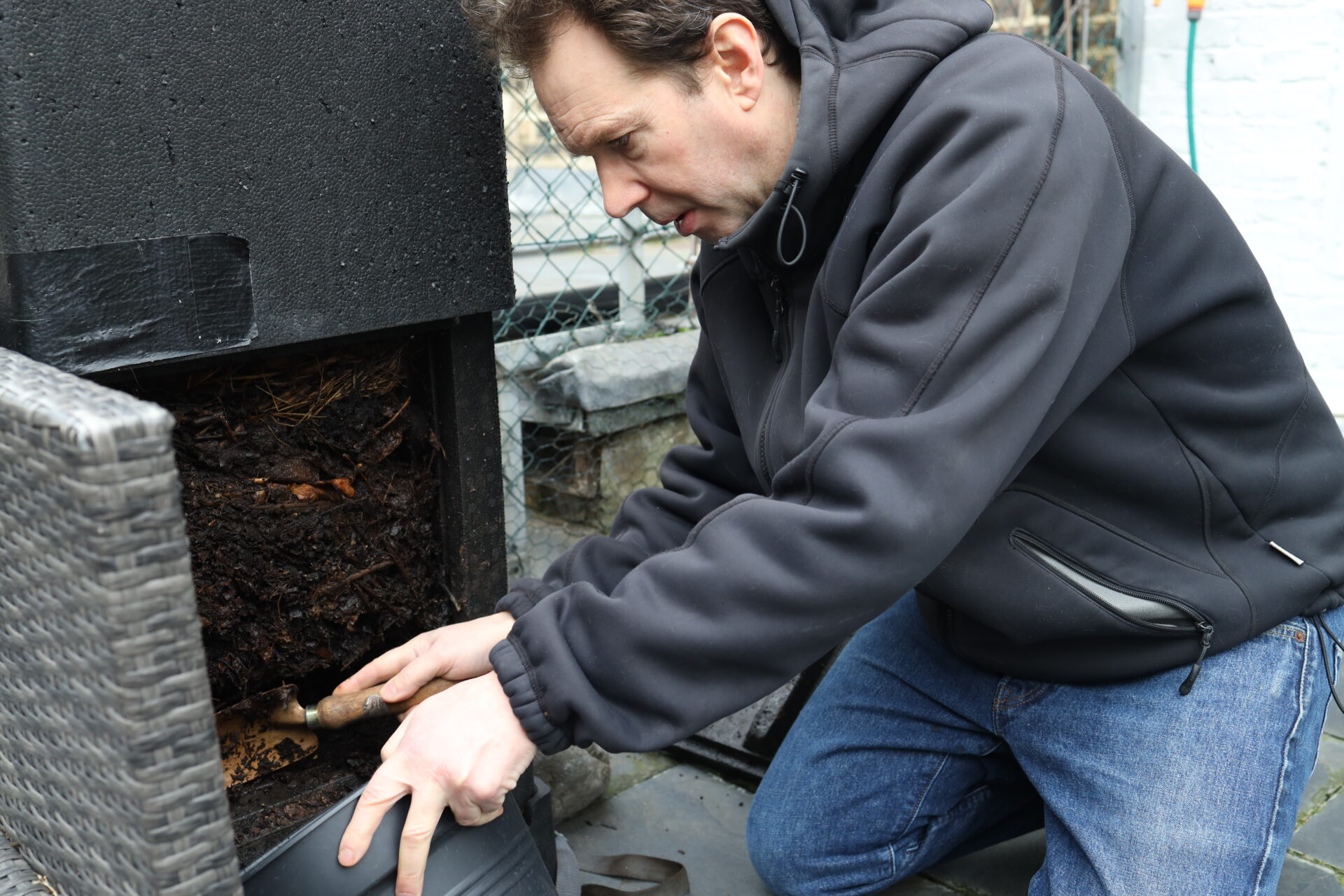
I didn’t expect that my composting would smell and upset my neighbours. However, without enough circulating air the process turns anaerobic and does create a pong. One has to be sure that sufficient oxygen is penetrating the pile, to which end last year I drilled holes in a copper plumbing pipe and plunged it through the stack. That did the trick. The only persistent pest is not rats (that’s why one shouldn’t be in a hurry to compost scraps of meat or cooked food) – but our black cat Kiki who positions herself on the bin’s top, now having clawed its sides to shreds. No matter, it still works, and the resulting compost has produced many fine crops like these my winter brassicas.

 
The fine art of composting
I wish I could pretend to be a master composter. I visited the legendary Charles Dowding at his Homeacres garden in Somerset in 2022 and marvelled at the quality of what he is able to produce in his huge, roofed bays from an abundant supply of garden waste. Compost, and its application as a surface mulch, spread like marmite on a slice of toast, works brilliantly in a no dig system. Not digging the soil preserves its natural structure, doesn’t disturb soil microorganisms, and keeps the fine threads of mycorrhizal fungi intact. Composting at this rarefied level takes on a Vedic, cosmic dimension as a dramatisation of the cycle of life.

Compost as a process in culture
I came to gardening from a background of music. And there are unmistakable connections between the practices. The mix, like the creation of a good compost heap, requires carefully-selected ingredients – and only when everything is in the right balance will the alchemy occur. As WOEBOT I composed a number of sample-based EPs and LPs – highlights being Moanad (2010) and Chunks (2011). These were made from the discarded remnants of seventies rock, whereas now I’m working with weeds, kale stalks, and the brown-paper packaging from deliveries.

Compost as our salvation
I’ve mentioned compost’s high seriousness. And, truthfully, its ecological importance can’t be underestimated. We throw away, as though it were rubbish, a truly disgraceful amount of organic matter. It is piled up in municipal rubbish heaps, burnt, or in the case of our “humanure” flushed out to sea. The Chinese civilisation, the “Farmers of Forty Centuries” that Professor F.H. King studied in his landmark book of 1911 would have been appalled by our neglect of this valuable resource. We forget at our peril that the soil which grows all our food is a precious and rapidly diminishing resource.

20.3.25

Hands on the Land

Article for WWOOF

Writing in a postscript to his classic book “The Fat of the Land” in 1974, self-sufficiency guru John Seymour proposed of his smallholding at Fachongle Isaf, “If there were enough people on it — enough hands — I believe that our seventy acres could produce a dozen times as much food as it did before.”

Quite soon after this, in defiance of his wife Sally who had previously urged him “Oh no – we don’t want to start some bloody community!” Seymour had drawn in young back-to-the-landers to live with them in Wales and help. Ann assumes the role of foreman, Paul takes over the pigs, Anushka drifts into looking after the dairy, and Eddie (a vegetarian) takes over the house gardens. Seymour himself notes “…somehow everybody crawls out of bed very early in the morning for the milking (except me – I meditate – in a horizontal position).” Perhaps he was scheming, as he was wont, on the imminent future? As he writes, “We must start preparing now for the collapse of the technocracy. We must build the framework now that will be ready to receive the people who will one day flee from the decaying cities and clamour for their birthright — their fair share of their own country.”

That catastrophe hasn’t happened yet, thank goodness, but if we heed the warning of author Chris Smaje in “A Small Farm Future” (2020), just as John Seymour advocated fifty years ago, a robust response to both climate change and food security lies in downscaling industrial agriculture and its massive monocultures to smaller “mixed” farms. To increase yield in those circumstances, as Seymour explains, goes hand-in-hand with the need for more skilled agricultural workers. The techniques of industrial agriculture have meant that, by the combination of heavy machinery and prodigious use of chemical fertilisers, very little labour is required. A single farmer can often manage 1,000 acres on his own. But at what cost to our ecology, nutrition, social cohesion, and sanity?

Genuinely free-range chickens on Sustainable Food Trust supremo Patrick Holden’s farm

It was this situation into which the WWOOF organisation first germinated. In an interview for SEED magazine, Sue Coppard noted of organic farms, “it occurred to me—correctly—that such places might be more inclined to use unskilled labor than a big, commercial farm.” Patrick Rivers, another once well-known self-sufficiency advocate, and contemporary of John Seymour’s, writes in his book, “Living on a little land” (1978): “Some years ago a lass called Sue Coppard started a small revolution. Sue wanted to escape the restrictive boredom of weekends in the city, not merely to flop, but to balance the work of her head with the work of her hands.” Rivers described of his own smallholding how he and his wife Shirley, “…could never have achieved what we have without the help of scores of “WWOOFers” who have come to us – most of them for weekends, some for stretches of several weeks… I can recall none who have not shared our views on living more simply, and on the need to bring about a gentle revolution by setting an example.”

For the past few years, I have been writing and researching a book entitled “The Garden: Visionary Growers and Farmers of the Counterculture” [see below] For the book I interviewed many first-generation farmers who, inspired by their experiences at the end of the sixties, went back to the land to farm. The likes of Eliot Coleman, Sustainable Trust supremo Patrick Holden, and Permaculture co-originator David Holmgren, like many of the willing workers of WWOOF, did not come from the countryside or farming families. One and all responded to an impulse to get out in nature and work the soil.

One of my interviewees, another veteran of the back-to-the-land movement, Dave Chapman of America’s Real Organic Project noted, “The other thing… is that when I did start to farm — and I was gardening before I was farming — I loved it. I loved the smell of the soil. I love working in that way with my body. I loved watching plants grow. It was all pretty much, you know, as they say, as much fun as you could have with your clothes on.” Certainly, there was less money to be made, but as John Seymour described his own rural labour, in a possibly exaggerated way, “If I were to work in an advertising agency I would want my labour to be assessed not at ten shillings or a pound an hour, but at a million pounds an hour.”

Patrick Rivers adds that, “Besides helping both farmer and learner, WWOOF plays a small but valuable role in bridging the gap between city and countryside and reviving interest in the land.” This connection which WWOOF offers people living in the cities to the land is even more precious to us today in 2025. The gap Rivers refers to is now more like a chasm. In 1962 the American theorist Murray Bookchin could write, “The city man, to be sure, does not need to be reminded that good soil is important for successful farming. He recognises the necessity for conservation and careful management of the land. But his knowledge of food cultivation — its techniques, problems, and prospects — is limited.” Today it is only possible to imagine a mere fraction of city dwellers having even this awareness. The thoroughly misguided institution, and the recent collapse of the urban hydroponic infrastructure [watch a video about this here] plainly unsustainable to anyone with even a rudimentary understanding of vegetable production – clearly reveals how little understanding of the precepts to which Bookchin refers to are grasped by city dwellers.

I came away from writing the book “The Garden” with a feeling that the encouragement of people living in cities to understand the importance, the sanctity even, of organic food production is vital for the future of sustainable agriculture. Yes, in the best case scenario, that would involve people volunteering for WWOOF and actively participating – but equally, as was advised by pioneering organic scientist Sir Albert Howard, urbanites such as myself can do our bit by buying organic food, and gardening organically, if only on our window-ledges.

Well, we hope you enjoyed reading this article by Matthew Ingram. His book The Garden comes out on 8th April and has some really good endorsements; here’s one by Charles Dowding (author of No Dig) “Matthew Ingram has not only investigated a huge amount of material and talked to many people, he also has an ability to bring it all together in a way that makes sense and is fun to read.” 


7.3.25

Unpublished Essay for the Soil Association

 The Organic Counterculture

It seems like everybody wants to be the “real” rebel these days, ever since the idea of alternative culture proved to be the hottest-selling ticket in town. Did that process start with the rock group Nirvana’s “Nevermind” album, Apple’s “Think Different” advertising campaign, or the advent of social media platforms like “X”? Organic farmers and merchants must have thought they were safe. Who could possibly connive to topple them from their perch as the righteously definitive opposition to industrial agriculture?

However, amid the barrage of PR funded by the bottomless pockets of chemical manufacturers, the as yet unregulated claims of regenerative agriculture, and now the proclamations of precision fermentation, the voices of what farmer Eliot Coleman calls “biological” agriculture have become harder to hear amidst the din. In the United States the organic standard has become dangerously eroded. USDA Organic regulations have been bent so far out of shape that both hydroponic growing and Concentrated Animal Feeding Operations now qualify. America’s Real Organic Project was set up in 2018 and provides an add-on label to the USDA Organic standard, to provide a corrective in line with the organic pioneers’ vision. Were it not for the rude health of the Soil Association, Lady Eve Balfour would be turning in her grave.

Amid these claims and counter-claims it becomes hard to chart the way forward for sustainably biological farming, to appreciate what we already have in the Soil Association. I’m the author of “The Garden: Visionary growers and Farmers of the Counterculture” (2025) and it’s my contention that to discover the true rebel spirit opposing industrial agriculture, we need to turn to the hippies. Writing the prequel to “The Garden”, a book titled “Retreat: How the Counterculture Invented Wellness” (2020) in February 2018 I had interviewed former Soil Association chairman and biochar pioneer Craig Sams about Macrobiotic food. The diet was described playfully as “kosher for hippies”. When we spoke, Sams had repeatedly referred to the soil’s role in promoting good health. In the first instance I was baffled – but over time I came to understand this logic, fundamental to the organic movement, and grasp how the hippies with their ethos of natural living felt a connection to ideas of the living soil.

However, when it came to the question of the hard graft involved in farming, with the legendarily “relaxed” hippies immediately there was a glaring issue. One of my interviewees, alone in electing to remain anonymous, reported the story of a Biodynamic colleague who was looking for someone to take on his farm, “He said, I don't want a poet. Properly doing agriculture is a path and it's not about wistfulness. It's not about “Ooh isn't that nice!” It's about getting up at four in the morning and going to bed at eleven o'clock at night… But at the same time, it takes a huge amount of focus, attention and energy.” As agricultural theorist Wendell Berry put it to Mother Earth News in March 1976, of the more feckless members of the counterculture, “I have a lot of enthusiasm, but I know how far it will get me. It doesn’t last until dark when you’ve got a full day’s work, or three or four days’ work, to do in a day. If you get all the way to dark and to the end of the job, then you’re going to be operating on something else.” Nevertheless, in spite of the movement’s reputation for impractical idealism, it might come as a surprise that the hippies that went into growing and farming turned out to be both obstinate and unsentimental.

Perhaps hippie farmers of that generation aren’t as numerous as they might be? Michael O’Gorman, who ran farming at guru Stephen Gaskin’s mega-commune “The Farm”, where at its high point he fed 1,500 people, lamented, “I think of all the dozens and dozens if not hundreds of people that I knew that were all going to be farmers, and at that time thought they'd be farmers for the rest of their life. The only two people I knew out of that period of my life that stayed with it were myself and my brother.” But by some quirk of fate, former hippies of the back-to-the-land generation ended up being some of the most influential figures in the organic movement. This including O’Gorman himself, who built three of North America’s largest and most influential organic vegetable farms and then went on to found the remarkable Farmer Veteran Coalition, where, to paraphrase Isiah 2:3, they literally beat swords into ploughshares.

I also had the honour of speaking to hippie giants such as Sustainable Food Trust supremo, Biodynamic patron, and former Soil Association director Patrick Holden. I sat round the kitchen table with America’s legendary and innovative grower, Eliot Coleman who proudly describes himself as “an old hippie,” and was regaled with countercultural tales by the co-originator of Permaculture David Holmgren. It seemed as though that, if “enthusiasm” wasn’t the vital ingredient the hippies availed themselves of, they drew durable ideological sustenance from the higher ethics which the counterculture promoted.

The appeal to the hippie generation of the Organic movement was, according to Gurney Norman writing in the hippie bible The Whole Earth Catalog in the early seventies that, “The whole organic movement is exquisitely subversive. I believe that organic gardeners are in the forefront of a serious effort to save the world by changing man's orientation to it, to move away from the collective, centrist, super-industrial state, toward a simpler, realer, one-to-one relationship with the earth itself.” Heeding President Eisenhower’s farewell address of 1961, with its ominous warnings of a “military-industrial complex”, the counterculture saw connections between the war in Vietnam and Dow and Monsanto, agricultural herbicide manufacturers, who acted under instruction from the U.S. government to produce Agent Orange. The herbicide, containing a chemical called dioxin, defoliated millions of acres of forests and farmland in Vietnam. The Vietnamese government says up to 3 million of its 84 million people have birth defects or other health problems related to dioxin. There seemed no better way to stand up to corporate America than in going organic, as farmer Jake Guest put it in an interview with the Real Organic project’s Dave Chapman. Of the small farms that disappeared, “They were taken over by the big corporations who took over the food industry. It was all connected, Vietnam, corporate America — these are not nice corporations.” Guest decided that it was a “no-brainer” that they grow their own food, and taught himself from books, the Rodale tomes, but also noted, “The British have a whole bunch of practical farming books… they tell you exactly how to plough a field…”

The British, especially Lady Eve Balfour and Sir Albert Howard took on legendary standing in America. Howard’s writing was inspirational to J.I. Rodale. Mildred Loomis, referred to as “the grandmother of the counterculture” because of her innovations in intentional communes, reports Rodale’s comments upon discovering Howard’s writing in Ralph Borsodi’s library, “The impact on me was terrific! I decided we must get a farm at once and raise as much of our family’s food by organic methods as soon as possible.” Eliot Coleman described meeting Balfour herself at an evening arranged by the Soil Association at a pub in London. After the encounter, one of Coleman’s group, a hardcore old leftist, turned to him, ““Damn,” he said, “If that's the aristocracy I think there should be more of them!” He was so impressed. And so was everybody else. She was just incredible.”

21.2.25

Alan Watts

A stack of books on a wood surface

AI-generated content may be incorrect.

Watts stack.

With this, I am perhaps turning the last page on my research of the counterculture. When I finished “Retreat” I took a road which led me into the unusual terrain of self-help literature and the applications of psychoanalysis to business. That resulted in the comic book “TPM” which I remember as being incredibly satisfying to make. In due course, I’m going to do another print run of that.

In 2022, I was also busy with the “The ‘S’ Word,” another counterculture book, but about music and spirituality. Simultaneously, starting in August 2021, I was reading the books that informed “The Garden.”

Coming out of “The Garden”, headed back-to-reality as it were, I’m not inclined just yet to go on another research trip. I need to sort things out here on the material plane otherwise, as Stephen Gaskin put it, I’ll be “flappin’ in the breeze.” Therefore, currently, I only have a small pile of books to work through. Top of that list, sayonara to the mystic counterculture if you like, was Alan Watts’ autobiography “In My Own Way” (1973) which came out the year of his death.

I’ve read a number of Watts’ books, and they are uniformly enjoyable. Reading Alan is quite like reading a blog by someone very erudite. His writing is characterised by his freewheeling and informal authorial tone, which, because you’ve heard recordings of it, you can hear in your head. And he confesses many times in “In My Own Way” that he enjoys the sound of his own voice. His meeting with Carl Jung in 1958 is somehow emblematic of this, he reflects upon it that Jung “spent almost the whole time asking questions.” That’s another way of saying that although Alan was greatly impressed by Jung’s warmth, intelligence, and sense of fun, he didn’t really seize the opportunity to shut up and listen to him.

To be fair to Watts, this enjoyment of his own voice forms a part of his very healthy self-love. As he elegantly puts it, “since it is written that you must love your neighbour as yourself.” There’s not enough of that around. What we see on social media is the opposite, people showing off in a misguided attempt to curry each other’s respect and affection.

He’s certainly read all the important texts, and spoken to all the relevant people, but he lays it down in a very relaxed and non-judgemental way. But if the arguments in the books are always cogent, they are, even if he intended it so, a little thin on substance.

A green field with a mountain in the background

AI-generated content may be incorrect.

Mount Fuji across Paddy Fields.

There was a great deal I liked. I loved the numerous references to gardens, gardening, and gardeners (the last always satisfyingly grouped together with other denizens of the alternative underground: “…wizards, yogis, artists, poets, musicians, gardeners and madmen…”). Watts’ account of the potency of matcha confirmed what I suspected from my experience of it, “Mac-ha or koi-cha, the powdered green teas used for the ceremony, would doubtless be banned in this country if they were widely known, for, taken in strength, they are highly conducive to the states of consciousness characteristic of Zen meditation…”. And I jotted down notes of further places to visit from his luminous descriptions of Japan, should I ever get the chance to return…

However, what has really lingered with me is his, not exactly comfort, but acceptance of himself as a “weird” fellow, following his own “weird”. That’s something that I too am beset with. Indeed, close friends have advised me to dial it up a little more! Watts quotes at length this story from the Taoist philosopher Chuang-tzu:

The area of Ching-shih in the state of Sung grows fine catalpas, cypresses, and mulberries. But those of more than one or two spans in girth are cut down for monkey-perches; those of three or four for ridgepoles, and those of seven or eight for the solid sides of coffins for the wealthy. Thus they do not attain the normal term of their lives, and fall in mid-career to the axe. This is the danger of being useful.

In sacrifices of purgation one does not use bulls with white foreheads, pigs with large snouts, nor men with piles as offerings to the river. This has been revealed to the soothsayers, and such creatures are therefore held inauspicious [for sacrifice]. The sage, however, would regard them as highly auspicious.

Then there was a hunchback named Su. His chin touched his navel. His shoulders were above his head. His pigtail pointed to the sky. His innards were upside-down, and his thighs were against his ribs. By tailoring and laundering he made enough to live, and by winnowing grain he produced enough to feed ten. But when the authorities conscripted soldiers he stood in the crowd waving them off, and when a work-party was pressed into service he was passed up as an invalid. Yet when they doled out grain for the needy, he got three full measures as well as ten bundles of firewood. If a weird body helps a man live out his full term, how much greater would be the use of a weird character!

19.2.25

Brown Rice and Aduki Beans

 Craig Sams, who I have had the good fortune to interview for both my books published by Repeater, “Retreat” and “The Garden”, has used AI to make a song about Macrobiotic food. It came out rather well.

Sams makes the point that there’s almost nothing about Macrobiotics mentioned in the body of popular music. This is indeed strange given how massive the diet was in the hippie era.

In my research for Retreat I only came across two musical references, Don Cherry’s “Brown Rice”, and Bob Dylan in “On the Road Again” (“So I get brown rice, seaweed and a dirty hot dog.”) Sams had another good one, a novelty hit by Larry Groce, “Junk Food Junkie.”

Sams says the diet, “kept me in good health after I was unwell with hepatitis from my travels in Afghanistan and India.” At SEED, the restaurant favoured by Yoko Ono and John Lennon, he and his brother Gregory served Macrobiotic food.

A book with a yin yang symbol

AI-generated content may be incorrect.

From my library: Craig Sams’ book on Macrobiotics from 1972.

Macrobiotics wasn’t a diet per se – my own take on it was that it was a method of balancing your food to establish some particular cosmic accord. If you wanted the etheric high of a cave-dwelling saint, you should eat only brown rice: “Yin”. If you were prepared to slum it with the rest of us in samsara, you could have some whiskey: “Yang.”

However, it tended to be understood by the hippies as an injunction to only eat brown rice. In fact, if Macrobiotics is understood correctly, any grain would suffice! Researching for “The Garden” I came across self-sufficiency guru John Seymour quite correctly decrying this:

It is ridiculous for a whole generation of freaks in Britain to grow up thinking that the only good food to eat is “brown rice”, for example. We don’t grow rice in Britain. We grow wheat, and we should eat that – it’s a much better food than rice anyway.

John Seymour “I’m a Stranger Here Myself” (1978)

Several books on a tile floor

AI-generated content may be incorrect.

Macrobiotics books in my library.

I really went deep into researching Macrobiotics because, frankly, the depth is there. George Ohsawa’s early philosophical tract “The Unique Principle” (1931), published by the extremely highbrow and respected Vrin imprint, is one of the best books one can read about Eastern philosophy. In 2018, I visited sites in Kyoto frequented by Ohsawa and most notably the Macrobiotic HQ in Tokyo. I wonder if it is still there?

A building with a balcony and plants on the front

AI-generated content may be incorrect.A couch and chair in a room

AI-generated content may be incorrect.A bust of a person

AI-generated content may be incorrect.A display case with pictures and papers on it

AI-generated content may be incorrect.A typewriter on a table

AI-generated content may be incorrect.A group of luggage on a shelf

AI-generated content may be incorrect.A person touching a suit on a mannequin

AI-generated content may be incorrect.Two men standing next to a statue

AI-generated content may be incorrect.


18.2.25

Findhorn and the Hippies


Article at Celebrating One Incredible Family

This is the story of Matthew Ingram’s visit to the Ecovillage Findhorn in 2023. He came to do research for his latest book The Garden: Visionary Growers and Farmers of the Counterculture which chronicles how a generation influenced by psychedelics, Eastern philosophy, and reactions to Vietnam, the Oil Shocks, and DDT became interested in sustainable growing and farming. The book contains a chapter about what happened when the hippies came to Findhorn.

***

In August 2023, by train, plane, then taxi, I fulfilled a long-cherished ambition in taking the pilgrimage to Findhorn. Arriving in the middle of a rainstorm in the darkness, I gingerly let myself into “Genesis” the chalet that had once been the home of Eileen and Peter Caddy and their family. What had brought me to this enchanted site nestled on the dunes at Findhorn Bay in the North of Scotland?

I first heard about the intentional community at Findhorn when researching my previous book “Retreat: How the Counterculture invented Wellness”. It had been mentioned by one of my interviewees, pioneer of Holotropic Breathwork, Stanislav Grof. Grof had run a number of workshops at Findhorn and had a similar relationship with it to that he had forged with the Esalen Institute in California; the establishment of both, perhaps not coincidentally, was in 1962.

That previous book had looked at different techniques of healing against the backdrop of the hippie movement. There were a surprising number of candidates: Macrobiotic food, Transcendental meditation, LSD Psychiatry, Transactional analysis, and Esalen’s Gestalt Practice. But what I was unprepared for was the manner in which these were all tied into spirituality, and especially Eastern philosophy. That wasn’t the book I had set out to write! However, I ended up being fascinated by the holistic ideas of the Vedas, Buddhism, and Taoism.

Certainly, healing and its relationship to spirituality is a central motif of the community’s mission. It’s arguable that this need for revival was brought about by the trauma of the two world wars. Peter Caddy and Findhorn associate Richard St. Barbe Baker had both been in active service. With regards to the connection to Eastern philosophy, through the influence of Madame Blavatsky’s Theosophy, Peter Caddy had been transfixed by the spiritual culture of Tibet. Caddy was fortunate to travel there in 1945 just before the Chinese occupation. However, tellingly, he concluded of the experience that, “many of the people had become crystallised in their thinking and customs.”

It was, however, none of this that had brought me to Findhorn. In spite of Eileen Caddy’s view that the primary mission of the community was connected to her experience of the voice of god, “the still, small voice” and insistence that “the garden came second”, it will be eternally associated in the popular imagination with Peter Caddy’s giant vegetables. My latest book “The Garden: Visionary Growers and Farmers of the Counterculture” looks at the connections between the hippies and growing. It takes in forebears like Rudolf Steiner and the UK’s organic movement (Lady Eve Balfour herself no stranger to the community), Self-sufficiency, the back-to-the-land movement, Masanobu Fukuoka’s Natural farming, Permaculture, and much else besides.

 Given that the “hippie farmer” is one of the best-loved and durable figures in society, a trope even, it is a wonder that such a book hadn’t been written before. Oh certainly, Tompkins and Bird’s “The Secret Life of Plants” (1973) was the foundational book of the plant-consciousness counterculture, but it didn’t discuss the hippies themselves – only their putative influences. Peter Tompkins can be seen talking to journalist and television presenter Magnus Magnusson in a wonderful BBC TV special on Findhorn from 1973.

The book’s final chapter concerned the community at Findhorn. Reading extracts from it published in Harper’s Magazine, as he sat in his cluttered and shabby warehouse in the old industrial section of Boston, Paul Hawken, author of the subsequent “The Magic of Findhorn” (1975) was rendered “psychologically flatfooted and analytically agape” – and set off on his own pilgrimage to visit.

The world of the founders of the spiritual community at Findhorn is referred to by Celebrating One Incredible Family chronicler Cornelia Featherstone as one of “tweed” but my book concerns the counterculture, that intense revolt of the youth against straight society that peaked in 1968-69 with The Beatles “White Album”, the Parisian student riots, Woodstock, and the back-to-the-land movement.

As Cornelia puts it, the original founders were at work in a field that was, “very specific and quite esoteric in the true sense of the word, ‘Not seen’.” Arguably, it wasn’t until the small community’s discovery by the hippie movement that it became what it remains to this day. Right at the heart of its visionary offering, setting it a decade ahead of other early intentional communities, was Peter Caddy’s vegetables. I had the good fortune to be able to talk to some of those original hippie visitors, briefly with Paul Hawken (now the world’s leading sustainability guru), with another key American émigré from that era, the sparkling Roger Doudna, who still lives in the dunes, and with Leonard, one of the original gardening “gnomes” who arrived as a gang from Blackpool in 1971.


Living Machine

Being guided around the site by the delightfully bossy Caroline Shaw, I was able to see firsthand the ways in which growing food and working with plants is still central to the Ecovillage Findhorn community. Caroline let us into the magnificent water purification plant, set up in collaboration with expertise from Cape Cod’s New Alchemy Institute (featured in another chapter of my book), where reeds are used to convert grey water till it’s clean enough for goldfish to happily live in it.

Cornelia’s greenhouse

Cornelia Featherstone showed me around her magnificent vegetable garden which has already, thanks to a lovely film by internet gardening sensation Huw Richards, attracted worldwide attention with half a million views. Cornelia’s garden was, in the true ‘spirit of Findhorn’ like Peter Caddy’s before her, growing biologically without chemicals; that’s to say in accordance with nature. This choice of growing methods, and indeed the whole organic movement, were closely followed by the countercultural generation.

Michael Shaw led me around the Community Supported Agriculture garden on the site, which was being tended by WWOOFer Veronica Caldwell, returning from Australia to Findhorn where she grew up, and now a highly-skilled grower.

On a walk into Findhorn itself I was delighted to encounter some actual massive fruit. In this case rose hips reaping the benefit of a whole summer of long days. There has been much speculation over the years as to the causes of Peter Caddy’s forty-pound cabbages. Was it the devas? Without wanting to spoil anything, this matter is explored in the book with some interesting new material which came to light in my research. In strictly literal and ecological terms though, the real miracle is how a vibrant topsoil has been created upon such unpromising land. Ecovillage Findhorn, long may she grow!

“The Garden: Visionary Growers and Farmers of the Counterculture” by Matthew Ingram will be published on April 8th 2025 – but is available as a pre-order.


12.2.25

RHS Level 2 Principles

A stack of papers on a table

AI-generated content may be incorrect.

My stack of course notes.

Between August 2021 and December 2024 I was researching and writing this forthcoming book about gardening, growing, and farming. Yes, I did learn a lot about those topics in my reading, watching, and interviewing (and can confirm, looking back with what I know now, that I didn’t make any mistakes!) – but I wanted to double down on that research for three reasons. Firstly, I wanted to make sure I really knew from a scientific and practical point of view what I was talking about. Secondly, I wished to learn more about plants purely out of personal interest. And thirdly, I had a view that this might be a qualification useful to me to get work. What shape that work would take, still not being totally clear to me yet.

Something that came up whenever I was looking into this area, as I was as early as October 2020, was the Royal Horticultural Society’s Level 2 qualifications. I’m glad I waited, because in September 2022 the course was updated, and it’s more appropriate to my interests now. There’s now a strong emphasis on biodiversity and sustainability. And with the introduction of conceptual tools like the Garden Health Plan (which combines abiotic and other factors with previous techniques like Integrated Pest Management to create a panoptic view of health), the whole course is by definition holistic in its perspective.

A book on a table

AI-generated content may be incorrect.

The RHS: Not just about ornamental horticulture.

Before making the leap, I reached out to legendary gardener Jack Wallington, author of the classic “Wild about Weeds” and he kindly reassured me that the course was also very applicable to vegetable growing. Indeed, the RHS isn’t just about ornamental horticulture. Many of the figures in its hall of fame have an interest in what’s termed “productive growing” and “edible landscapes” – like, for instance, Rosemary Verey and William Robinson. Any residual snootiness towards growing food seems to be, if not entirely absent, then gradually eroding away. Certainly the high rigour and impeccable standards of the RHS are exceptionally useful in that sphere.

A diagram of a plant growth

AI-generated content may be incorrect.


At the end of July last year I made a start revising for the RHS Level 2 Principles exam (on the right in the image above). The Practical half of the course is more weighted towards ornamental horticulture which, at the moment at least, I am less interested in. For instance, I’ll wager that 95% of the plants one is expected to identify in the Practical course are jazzy shrubs, roses, and ornamental grasses. However, to the contrary, I’m happiest identifying: flowers that pollinators like, herbs, fruit, wild flowers, weeds, crops, and trees. And I was able to bend the Principles’ syllabus to accommodate that preference. Indeed, I leave the course with a huge “My Plants” spreadsheet which I compiled of plants that I love which illustrate various horticultural points. For giggles check out this large entry, only one of 238, which I compiled:

Like other of the Rosaceae family can be affected by fireblight. A lack of calcium causes malformed dead cells scattered through the fruit called “bitter pit”. Apples suffer from apple scab, powdery mildew, orchard fireblight etc. Seed designed to be eaten and then pass through the digestive system of birds or mammals far from the parent plant. Fleshy portion removed if planting horticulturally. An important early-flowering resource for bumblebees and mining bees and a key nectar resource for early hoverflies and bee-flies. Orchard trees decay more quickly than say Oak and cavities which open out in them can be homes for Great tits and Spotted woodpeckers. Orchards also home for Bracket fungi. Different cultivars of apples require different cumulative hours of cold in the winter to produce flower buds. Chemical inhibitors prevent germination. Self-incompatible – has to be pollinated by a different plant.

My Malus domestica (apples innit) spreadsheet entry

Another advantage of the Principles course is that it can be done remotely – but that’s changing with the advent of at least one provider offering blended learning for the Practical course.

A book with white flowers

AI-generated content may be incorrect. 

One of the most highly recommended texts. My edition already out of date.

The RHS Level 2 material is typically described as being equivalent in difficulty to a GCSE. It’s been 37 years since I sat one of those! However, and here’s the clincher, the volume of information is enormous. One of my fellow course mates had this to say, “I came into Horticulture after 27 years of teaching GCSE at secondary level. Compared to what I have taught, the level of detail and volume of work in the syllabus seems massive.”

Add to this the ornate and convoluted way that the RHS asks questions, (from the same observer), “It felt as though the questions were deliberately trying to trip you up or focusing in on one minute detail rather than being a test of your breadth of knowledge.” That tricky way of asking questions (where it’s also not entirely clear what you’re supposed to be replying with in your answer), tripped me up on multiple occasions in my revision. It led, depressingly, to numerous failed pilot tests and dismal marks, even when I was reasonably confident of the material.

A book with a flower on it

AI-generated content may be incorrect. 

Peter Dawson’s swan-song. A handy resource for both Principles and Practical courses.

I do hope that none of this discourages people from doing the RHS Level 2 Principles course. If you get a decent provider with solid learning material, then it’s totally great. Bloody marvellous. I LOVED IT. I learned so much, and was genuinely fascinated by 99% of the material. Only garden design, of which there is only a little, left me cold – and to be fair, I am coming at all this from what is to most people today a very weird angle.

I sat the two unit exams this Monday and Tuesday after cramming the material very hard through December and January. I won’t get the results for a few months – and I’m really hoping I pass. However, if I fail I will pick myself up again and have another crack at it. It will be another opportunity to learn some more wonderful information


7.2.25

Fosco Mariani on Life

 A book with writing on it

AI-generated content may be incorrect.

An edition of Fosco Mariani “Secret Tibet” with debossed Mani mantras.

I stumbled across this passage a few years ago in Fosco Mariani’s “Secret Tibet” (1951) – one of the great accounts of travel in Tibet before the Chinese occupation. Very beautifully and without recall to superstition, it encapsulates the vedic idea of the individual human’s spirit as a fragment of the larger universal consciousness; I think it would make an excellent reading for a funeral.

Running water reminds one strangely of human life. It first emerges so thin and small and devoid of strength. In its infancy it runs sparkling through meadows, among flowers and shining stones. Then the waters gain in weight and vigour and rush downhill; their youth is bold and happy, a time of singing and dancing in the sun, celebrating noisy marriages with tributaries, forming crazy little waterfalls and exultant little lakes. All is joy and high spirits. But gradually the slope diminishes, and the stream grows and becomes a river; youth turns into manhood. Its course is now more regular; it no longer runs crazily, but has become sensible and strong. It is less beautiful, but has become useful to agriculture and industry. What makes it attractive now is its calm, serene maturity. Enthusiasm, love, passion, beauty, have given way to quiet, useful purposefulness. At last it imperceptibly approaches the estuary; the lagoon-like expanses, the sadness and sweetness of old age. Then it once more mixes with the original waters.

Fosco Mariani: “Secret Tibet” p287-288