Addicted to Humus: Matthew Ingram on the Revolutionary Potential of Compost
Matthew Ingram, aka Woebot, is an author and researcher in countercultural history. He found his way into a wider study of countercultural activity from a start as a music journalist covering domestic avant-garde scenes like Jungle and Grime. His first major book, Retreat: How The Counterculture Invented Wellness (2020) looked at health methodologies like Transcendental Meditation, LSD psychiatry, and macrobiotic food.
Its sequel is another first-of-its-kind investigation into the generation that took LSD, went back-to-the-land, grew organic food, and pored over The Secret Life Of Plants. His book, The Garden: Visionary Growers And Farmers Of The Counterculture, is published in April, and looks at how with phenomena such as permaculture, the natural farming of Masanobu Fukuoka, and deep ecology, the counterculture set the template for the sustainable agriculture of today.
Ingram is, like many recent converts to the horticultural arts, a keen gardener. However, it’s compost itself and the dark arts of making soil which has caught his imagination, as much as growing itself.
My journey into compost
Gardening is a voyage of
discovery. Once I had nailed growing seeds into seedlings, and had
successfully planted them out in a raised bed, I looked around to see
what else I could try my hand at. Shop-bought compost, the good stuff
like Dalefoot, Moorland Gold, or Carbon Gold, is very high quality but
expensive. So rather than waste material from the garden or kitchen,
it’s thriftier, and frankly more fun and interesting, to turn it into a
useful growing medium.

Composting 101
Whenever I think of compost my
mind wanders to The Fast Show and its character “coughing” Bob Fleming
and his “Country Matters” spot. But compost is a deadly serious
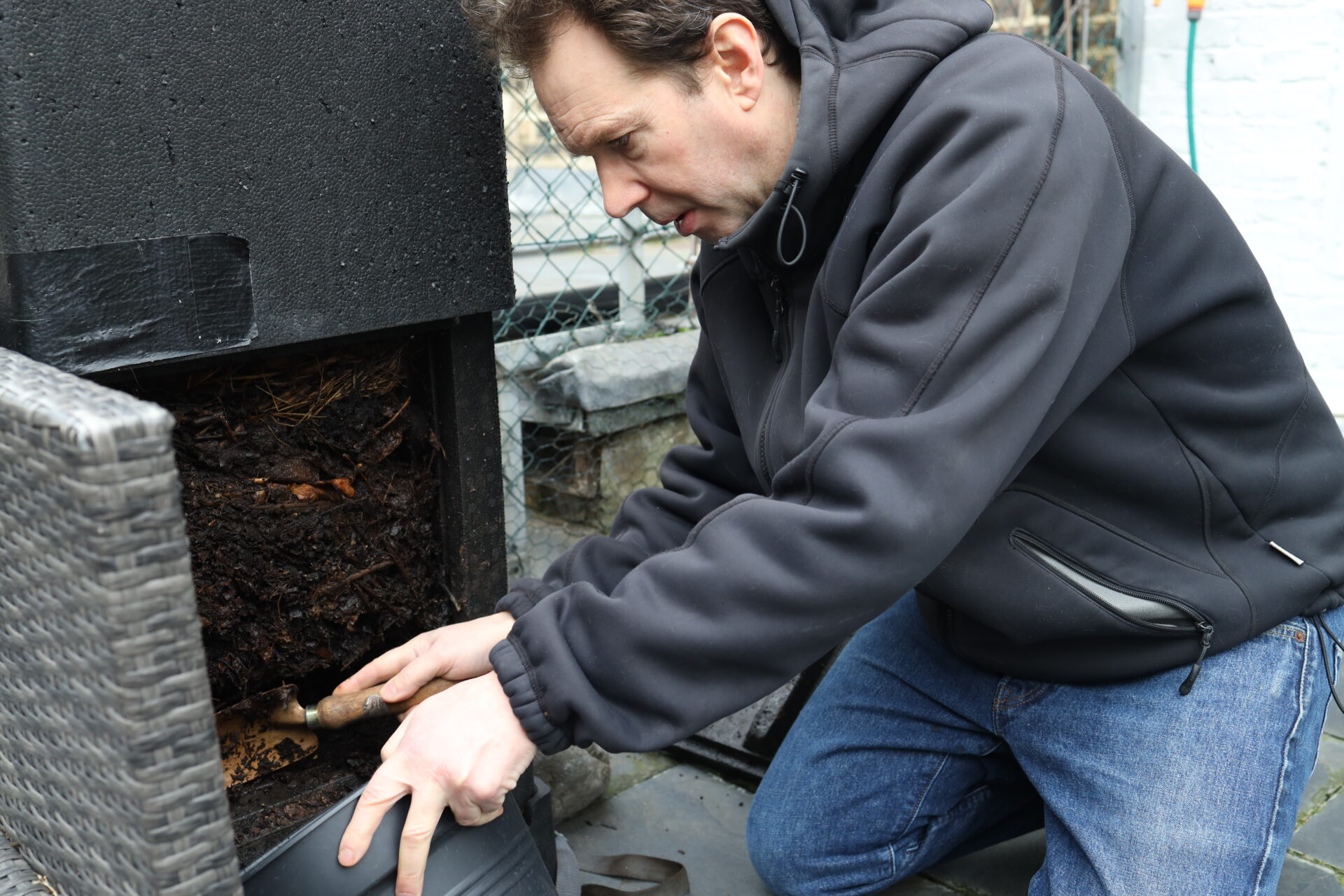
business. I started doing it on my urban roof terrace in 2023. In layers
you combine “green” matter rich in Nitrogen (not technically green this
can be uncooked vegetables and any fresh garden waste) with “brown”
matter rich in Carbon (fine woodchip, shredded cardboard, and paper). In
the presence of oxygen, thanks to the action of bacteria, in its
thermophilic stage the temperature soars, and the heap (in my case a Hot
Bin) steams like an ocean liner. Composting does actually give off
Carbon Dioxide, but see it as a net positive process, at the end you are
left with a dark rich humus which is an ecologically valuable
suppository of stable carbon. The simple trick to identifying the
presence of carbon in soils, typically a residue of decayed organic
matter, is the soil’s darkness. If soil, a field for instance, looks
black or dark brown then it will contain a high amount of carbon,
possess a high fertility, and be alive with healthy microorganisms.
Compost in history
Researching my book The Garden
I ended up learning a lot about the history of compost. The process is
mentioned as far back as the Roman Cato the Elder’s “De Agri Cultura” in
160 BC. However, with the increasing reliance upon first guano, seagull
shit from the desert coastline of Peru in the 19th century,
rich in macronutrients which are rocket fuel for plant growth – and then
subsequently the widespread agricultural use of Sulfate of Ammonia
created in the Haber-Bosch process, mainstream growers and farmers
seemed to forget about the value of applying organic matter to the soil.
Whether it was properly composted animal manure or made from
agricultural waste and applied to the fields, the resulting soil, the
plants themselves, and the environment are healthier than when doused
with chemicals. Britain’s organic movement with its luminaries, the
swashbuckling Lady Eve Balfour and implacable foe of “the NPK mentality”
Sir Albert Howard, put compost at the centre of their rebellious
opposition to Industrial agriculture. Howard’s Indore method, devised in
collaboration and under the watchful eye of Indian farmers, produced
what might be seen as the “haute couture” of compost – even if not
regularly used by organic farmers in the UK the Indore method was a
valuable organisational principle for the organic movement.
Composting in the Inner-city
I didn’t expect that
my composting would smell and upset my neighbours. However, without
enough circulating air the process turns anaerobic and does create a
pong. One has to be sure that sufficient oxygen is penetrating the pile,
to which end last year I drilled holes in a copper plumbing pipe and
plunged it through the stack. That did the trick. The only persistent
pest is not rats (that’s why one shouldn’t be in a hurry to compost
scraps of meat or cooked food) – but our black cat Kiki who positions
herself on the bin’s top, now having clawed its sides to shreds. No
matter, it still works, and the resulting compost has produced many fine
crops like these my winter brassicas.

I wish I could pretend to be a master composter. I visited the legendary Charles Dowding at his Homeacres garden in Somerset in 2022 and marvelled at the quality of what he is able to produce in his huge, roofed bays from an abundant supply of garden waste. Compost, and its application as a surface mulch, spread like marmite on a slice of toast, works brilliantly in a no dig system. Not digging the soil preserves its natural structure, doesn’t disturb soil microorganisms, and keeps the fine threads of mycorrhizal fungi intact. Composting at this rarefied level takes on a Vedic, cosmic dimension as a dramatisation of the cycle of life.
Compost as a process in culture
I came to
gardening from a background of music. And there are unmistakable
connections between the practices. The mix, like the creation of a good
compost heap, requires carefully-selected ingredients – and only when
everything is in the right balance will the alchemy occur. As WOEBOT I composed a number of sample-based EPs and LPs – highlights being Moanad (2010) and Chunks
(2011). These were made from the discarded remnants of seventies rock,
whereas now I’m working with weeds, kale stalks, and the brown-paper
packaging from deliveries.
Compost as our salvation
I’ve mentioned compost’s
high seriousness. And, truthfully, its ecological importance can’t be
underestimated. We throw away, as though it were rubbish, a truly
disgraceful amount of organic matter. It is piled up in municipal
rubbish heaps, burnt, or in the case of our “humanure” flushed out to
sea. The Chinese civilisation, the “Farmers of Forty Centuries” that
Professor F.H. King studied in his landmark book of 1911 would have been
appalled by our neglect of this valuable resource. We forget at our
peril that the soil which grows all our food is a precious and rapidly
diminishing resource.