Showing posts with label Growing. Show all posts

22.11.25

Sick Veg 100


Twenty years ago at my blog WOEBOT, in December 2005, I made a list of 100 records.
 
For a couple of years I've been planning a 100 for the Sick Veg blog, but this time of non-fiction books. I first thought I would do it for Christmas - but I've had a little time free - so think of it as an early Christmas present. You're welcome.
 
This moment has arrived because I'm clearing my decks. Last week I finally got to the bottom of my pile of non-fiction books. I can date the start of this reading process with accuracy to 15th April 2017 when I ordered a copy of Theodore Roszak's "The Making of a Counterculture" and begun the research on "Retreat". Since that date, eight and a half years ago, I must have read close to two thousand books. One book lead to another - in most cases because it referred to another book that I ended up investigating - until the process felt complete...
 
The books themselves were not expensive, and it'd be inaccurate to think of this as an exercise in bibliophilia, with me showing off my valuable possessions. I was almost entirely concerned with their content. The real cost was the hours I spent reading when I might have been doing other things.
 
The books here are all ones which made a big impression on me, usually because the ideas they convey are luminous. I've broken down the one hundred I've chosen into the following categories: History, Psychoanalysis, Eastern Philosophy, Tibet, Philosophy, Beat, Theodore Roszak, Self-sufficiency, Acid, Anti-Psychiatry, Communes, Agriculture, Permaculture, Anthropology, and Self-help.
 
Strictly non-fiction, the list obviously doesn't include books of poetry (William Blake, John Donne, T.S. Eliot, Allen Ginsberg) or fiction (Charles Dickens, Virginia Woolf, James Joyce, Flann O'Brien, Herman Hesse, Jack Kerouac, William Burroughs, J.G. Ballard, Phillip K. Dick, Thomas Pynchon). But also not writing on music (Simon Reynolds, Lester Bangs, David Toop), on artists (William Blake, Henri Matisse, Paul Klee, Van Gogh, Edward Bawden, Andy Warhol, David Hockney, Jean Dubuffet, Robert Crumb, Moebius, Basquiat, Keith Haring, Brian Bolland, Yayoi Kusama), or practical growing (Eliot Coleman, Charles Dowding, John Jeavons).
 
Collected together I see these one hundred non-fiction books as the ultimate progressive "Behaviour Change" curriculum.
 

10.11.25

Eliot Coleman: "The Self-Fed Farm"


Great interview with Eliot Coleman at The Real Organic Project for his new book, "The Self-Fed Farm."
 
Coleman argues that vegetable growers can effectively generate their soil fertility with Green Manures.
 
To the layman, the city-dweller, this sounds like obscure, agricultural jargon. Eyes roll. Why should anyone care about this?
 
Because it's so totally critical, let me break it down for you:
 
1) Everyone survives by eating food.
 
2) While it is perfectly possible to survive by just eating plants, of course, the meat that is eaten is first fed on plants we grow.
 
3) Growing vegetable and grains is extractive. So if we want to keep eating food, and, er, living... we have to engineer properly sustainable ways of making a contribution back to that fertility. This is what Sir Albert Howard called "The Law of Return."
 
4) Industrial agricultural systems cheat the replacement of macro-nutrients (Nitrogen, Phosphorus, and Potassium) by importing them to the growing site at great expense to the farmer and the environment. As for micro-nutrients - they usually don't even bother providing them for the soil, which leads to a reduction in their presence in the food we eat that these Industrial systems produce.
 
5) Other agricultural systems also import fertility to the farm. This includes Organic as well as Regenerative (for which there is no legal framework and is basically a free-for-all). With Organic this can be animal manures or other organic matter which feeds the soil microbiology.
 
6) Eliot Coleman and a few other innovative Organic farmers argue that, rather than importing this Organic matter to the farm, it is possible to grow plants called Green Manures. These can be legumes like clover, vetch, alfalfa, and peas, or non-legumes such as mustard, rye, buckwheat, and phacelia. If these plants are grown in a farmer's rotation, and then chopped down into the top four inches of topsoil (not deep digging which would damage the soil), they can provide all the fertility that the soil requires. Furthermore, as the Green Manures break down on the surface they produce carbonic acid which etches valuable minerals out of stone in the top and subsoil.
 
It's a system as elegant as it is brilliant. Not a new idea, but one which needs all the publicity it can get. It has been elbowed to one side by not just Industrial agriculture, but also Regenerative agriculture. The latter, with its emphasis on No Till, to the delight of herbicide manufacturers who can keep on selling Glyphosate to farmers, has vetoed even the minimal tillage that the system Coleman describes requires.

8.11.25

Finding Lights in a Dark Age.

 I've absolutely loved Chris Smaje's previous two books.

Smaje has been locked in life-or-death tussle with the journalist George Monbiot - bravely articulating what many of us think about Monbiot's celebration of lab food. Monbiot here is reduced to a very brief cameo - somewhat like a pantomime baddy; mercifully diminished.

"Finding Lights in a Dark Age" is, instead, a much more personal book. Smaje draws on his experience of the realities of managing land and market gardening. I laughed when he said he has been described locally as "not really a farmer" because it highlights the sclerotic attitudes of conventional farming and the countryside's too-common snobbery.

Bang up-to-date with the latest academic and sociological perspectives, the book nevertheless falls into the grand tradition of radical self-sufficiency. One could be reading Scott and Helen Nearing or John Seymour.

J.G. Ballard's "The Drowned World" gets a very welcome mention and a highlight for me was the epic chapter twelve in which Smaje renders a genuinely excellent "Soi-Fi" projection of life in the South of England in the coming Dark Age he has conceptualised throughout the proceeding book. I'd read a whole book of that.

25.9.25

Nature is One and Indivisible.

 
You'd have to have a hard heart not to chuckle at F.C. King's name. And this IS Sick Veg after all.
 
I was delighted to find a cheap copy of this slender classic from 1951. I have restored it with a replica printed dust jacket. It was written in his capacity as the head gardener at Levens Hall in Kendall in Cumbria. King met Sir Albert when Howard was evacuated from his home in Blackheath, London in wartime 1940 to Heversham, just a mile away. As a result the text is topped and tailed by Howard.

John Harrison of "The Allotment Garden" says,

"Levens Hall’s ten acres of gardens date back to 1690s including the world’s oldest topiary gardens. Even though the days of estate gardens were fading following the First World War, being Head Gardener of something like Levens Hall was a very prestigious position."
I'd heard of King before but first came across the book when it was mentioned approvingly in Joseph A Cocannouer's "Weeds: Guardians of the Soil" (another classic). This is because King took an astonishingly progressive view of weeds,

"Everything in Nature has a definite place and it is our duty, as gardeners, to find a much better use for weeds in future than we have done in the past. Frequently I am amused at the amount of sympathy I receive from visitors when they see my weed crops. It is difficult to convince them that I deliberately encourage such growth on any piece of ground not immediately requiring food production..."

And he explains a number of advantages to their cultivation.

King, a compost evangelist, while not entirely a proponent of No Dig, says of compost that he did "not advocate digging it deeply into the ground. The best results I have obtained by its use have been on plots where it was kept reasonably near the surface."

Most bracing is his belief in the need to return organic matter from the city back to the countryside,

"For too many years townsmen and countrymen have tried to exist in a state of complete divorce the one from the other. Such a condition is wrong from every point of view. A campaign to educate the town-dwellers in their duty towards the land which is their heritage and from which they spring is long overdue."
The opening line touches a cosmic note in accord with my book, "The Garden". It starts, "Nature is one and indivisible..."

6.9.25

Winding things up

A tray of tomatoes

AI-generated content may be incorrect.A bowl of tomatoes and peppers

AI-generated content may be incorrect.A group of glass jars with food in them

AI-generated content may be incorrect.

I recently harvested my tomato crop and turned it into chutney.

It seemed like a good moment to reflect on four years of growing.

27.5.25

Gravetye Manor

 A hand holding a book

AI-generated content may be incorrect.A map of a garden

AI-generated content may be incorrect.A garden with plants in the background

AI-generated content may be incorrect.A garden with plants and trees

AI-generated content may be incorrect.A garden with plants and trees

AI-generated content may be incorrect.A garden with rows of plants

AI-generated content may be incorrect.A garden with plants and trees

AI-generated content may be incorrect.A garden with rows of plants

AI-generated content may be incorrect.A garden with plants growing in it

AI-generated content may be incorrect.A garden with plants and trees

AI-generated content may be incorrect.A garden with plants and flowers

AI-generated content may be incorrect.A garden with many flowers

AI-generated content may be incorrect.

To visit William Robinson’s oval vegetable garden at Gravetye Manor, we had to eat an expensive lunch, because the hotel that runs the site doesn’t let people wander around otherwise.

I think that, probably without question, this is the most important historic vegetable garden in the UK. Robinson (1838-1935), who reacted against the artificiality and strictures [edit: and impracticality…] of pompous Victorian gardens, developed his idea of the “Wild Garden”.

And there was room in his vision for more than ornamental horticulture. Robinson loved trees, and with this oval vegetable garden he showed how important growing food was to him also. Think of him, therefore, as one of the great horticultural rebels alongside the likes of Masanobu Fukuoka and Eliot Coleman. The garden is kept in rude health by head gardener Tom Coward – and provides an abundance of vegetables for the hotel.

18.4.25

JADAM Sulphur

This is my third and final JADAM post. Beyond JADAM’s pesticide and JADAM Microorganism Solution the third preparation which has appealed to me is JADAM Sulphur. or JS for short. JS claims to be “Effective against black spot, pear rust, powdery mildew, downy mildew, etc.” That’s to say as an “organic” herbicide treating fungal problems.

I don’t get much of this but what I do get I don’t like. Naturally I am doing what I can to make sure the soil health is as good as I can make it in containers, and that always needs to be one’s first step, but I need a little more help with these plants.

A plant in a pot

AI-generated content may be incorrect.

Here for instance is something which starts to affect my tiny apple tree’s leaves in spring, and by the summer has devoured the entire plant.

A close up of a plant

AI-generated content may be incorrect.

And here is a problem which affects the Acers in the back yard.

A table with a few bottles of liquid and gloves

AI-generated content may be incorrect.

As you can see from Youngsang Cho’s video on YouTube the process of making JADAM Sulphur for oneself is a little bit fiddly and dangerous, but not prohibitively so.

It’s actually remarkable that one can perform the necessary chemistry at all. In the JADAM Organic Farming book Cho elaborates, “After nearly 100 experiments, I found the method to completely liquefy sulfur. I have still not forgotten the joy I felt that time. My small kitchen was my lab, it was around 3 a.m. that I knew I finally made it.” After further tweaks which meant that you didn’t need steel containers (the temperature gets very high) and the process could be done in plastic ones instead of immediately patenting his method Cho disclosed the knowledge.

However, in no circumstances will I need the 100 litres of concentrated JS that the recipe produces. Not even a fraction of that. To spray the plants I wanted I needed only 1 ml. That would be different if I had a market garden to deal with. So again, I used the JADAM concoction made by Dr Forest.

A bottle of liquid on a table

AI-generated content may be incorrect.

For one litre of solution (and this was 75cl) you need 10 ml of JWA.

A bottle of liquid on a table

AI-generated content may be incorrect.

I added to that 1 ml of Liquid Sulphur.

A person spraying a plant

AI-generated content may be incorrect.A person spraying a plant

AI-generated content may be incorrect.

And sprayed it on my Japanese Maple and Amelanchier.

A person spraying a plant

AI-generated content may be incorrect.A person holding a lighter in a potted plant

AI-generated content may be incorrect.

On another Japanese Maple and my Apple tree.

Maybe that will mean they stand a better chance this year? I feel optimistic! I took greater precautions this time when spraying. Wore rubber gloves and goggles. But I neglected to wear a face mask which was stupid. Even at this tiny concentration the Sulphur’s fumes are very strong. Today, the following day, one can still smell it. Last night there were absolutely no slugs whatsoever in the garden. That is uncanny. So perhaps they don’t like the smell either. That would be a bonus.

A close up of a leaf

AI-generated content may be incorrect.A close up of leaves on a tree

AI-generated content may be incorrect.

One final reflection. I thought that using JWA, the wetting agent, was supposed to mean that one doesn’t get droplets like these when one sprays. That’s evidently not working for here.

All told I have enjoyed following these three processes. However, I am neither totally convinced as to their efficacy, nor particularly enthusiastic about spraying chemicals like these in my garden. How these plants sprayed with JS fare in the coming months will be something of a litmus test for me.

21.9.24

The Story of a Raised Bed

I had grown a little before November 2021, zinnias from seed and dahlias from bulbs in 2020, but never vegetables or indeed anything with serious intent.

It was a combination of two things, reading Theodore Roszak’s collection of essays “Ecopsychology” (1995) in August 2021, and watching an interview with Eliot Coleman in October 2021, that truly set me on this path. The latter providing the lightning bolt moment.

Immediately before this I had been reading Alfred Adler’s majestic “Understanding Human Nature” (1927), at the tail end of my research after “Retreat” , which carried on quite a long time after the end of that book’s publication in 2020. Indeed, I must have finished “Retreat” in mid 2019 and there I was still working through, not even yet fully integrating, the ideas I had unearthed in that book.

So, my journey into gardening had little to do with lockdown, as it did for many people. However, the same etheric conditions that we all experienced in lockdown, the ones which gave rise to other phenomenon like the huge growth in the amount of dreaming recorded in western populations, and the emergence of racial trauma out from the unconscious onto the social canvas, tracked in parallel my own etheric research into the dematerialised highs of LSD and meditation against the backdrop of the counterculture, and that generation’s subsequent post-countercultural integrated fascination with organic farming.

The immediate upshot was that I was keen to get involved somehow in growing food. I’m yet to totally work out how to make that transition in a meaningful way. It is, after all, a massive leap for a music-obsessed animator working in the centre of a city to undertake. A more etheric, less integrated existence it would be hard to devise, perhaps a coder working on a space station would be able to trump me? In consequence, the journey back to earth is harder to make.


A dumpster on the street

AI-generated content may be incorrect.

Working on my psyche art project, I got in the habit of picking up pieces of wood in the street. Some time in November 2021 I found two huge beautiful huge planks of wood in this skip on Pear Tree Street round the corner from where I live, and decided that they would make the basis of an excellent raised bed.

A staircase with a staircase and wood planks

AI-generated content may be incorrect.A table with tools on it

AI-generated content may be incorrect.A wood plank on a table

AI-generated content may be incorrect.A hand holding a bottle of linseed oil

AI-generated content may be incorrect.A room with wood planks and a weight plate

AI-generated content may be incorrect.A wood frame with a wood box and a couple of buckets of rocks

AI-generated content may be incorrect.A wood plank with tools on it

AI-generated content may be incorrect.A group of screws on a wood surface

AI-generated content may be incorrect.A wood square frame on a stone surface

AI-generated content may be incorrect.

I cut them to size outside in the street, soaked them in linseed oil to protect them from the weather, and assembled them with beautiful rust-proof, stainless steel screws. The frame looked great already.

A bucket of rocks on a stone surface

AI-generated content may be incorrect.A close-up of a wood beam

AI-generated content may be incorrect.

Because it was going to be resting on a slate roof, with a base level of large stones beneath the soil, I left a centimetre gap along the bottom to help with drainage. I didn’t want it filling up like a swimming pool and busting through the roof. Accordingly, I rested it straddled on top of a supporting wall which runs beneath the surface.

A cat walking in a wooden box

AI-generated content may be incorrect.A wooden box with rocks and gravel

AI-generated content may be incorrect.A rooftop patio with a building and a pool

AI-generated content may be incorrect.A wooden box with rocks and a plastic cover

AI-generated content may be incorrect.A wooden box with rocks and gravel

AI-generated content may be incorrect.A wooden box with dirt and rocks

AI-generated content may be incorrect.A wooden box with dirt and rocks on a rooftop

AI-generated content may be incorrect.A pile of dirt and rocks

AI-generated content may be incorrect.A wooden box with dirt on a patio

AI-generated content may be incorrect.A wooden box with dirt and a planter on a patio

AI-generated content may be incorrect.A wooden box with dirt and white plastic bags on a stone surface

AI-generated content may be incorrect.A wooden box with dirt and a planter on a patio

AI-generated content may be incorrect.

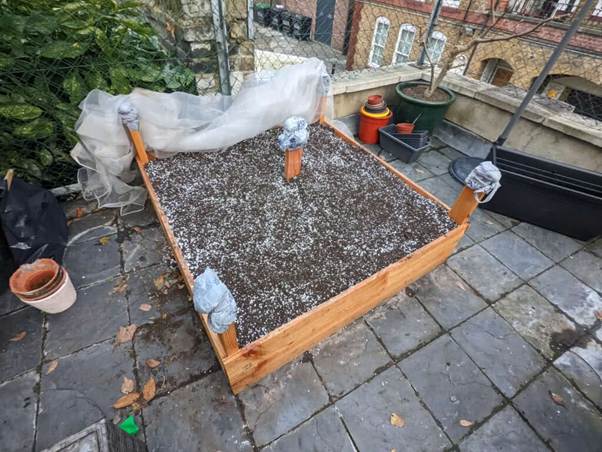
I designed the bed with a central column, so I could suspend mesh across it. The mesh to protect against insects, slugs, and snails. This worked very well, but was a faff to remove every time. Eventually, when it became clear that the black cat wanted to scramble over the top of it, I built a bamboo frame to rest upon the columns.

I bought a number of bags of a mixture of topsoil and compost. This is where I betrayed my ignorance, indeed none other than Charles Dowding rolled his eyes when I revealed to him that I had been convinced by a garden supplier that it was necessary to have a mix of the two. Compost on its own would have been superior. I mixed a huge bag of perlite in with this – both to lighten the mixture and allow it to drain better. I don’t really like perlite, an industrial product, with the benefit of hindsight biochar would have been better, if more expensive.

A rooftop garden with plants and trees

AI-generated content may be incorrect.

And so it was for nearly three years.

A plant in a box

AI-generated content may be incorrect.A garden with green plants

AI-generated content may be incorrect.A plant in a box

AI-generated content may be incorrect.A green plants in a garden

AI-generated content may be incorrect.A close up of a plant

AI-generated content may be incorrect.A person cutting a plant with scissors

AI-generated content may be incorrect.A garden with plants in it

AI-generated content may be incorrect.

Perhaps you’ve seen the pictures I’ve posted of all the things I grew here over the past three years? Carrots, Cabbage, Spinach, Pumpkin, Lettuce, Cavalo Nero, Rocket, and Beetroot. More besides.

A greenhouse covered in plastic

AI-generated content may be incorrect.

But this year it had to come to an end.

I got sick of the rigmarole of removing and replacing the netting. I’m figuring that a small greenhouse, or a cold frame would be more interactive, that I might have more fun with something like that if we stay put.

Also, I needed to tidy up the roof garden because we’ve put the house on the market and, well, it looked too bloody eccentric.

A garden with plants in pots

AI-generated content may be incorrect.

So everything got harvested.

A cat standing on a wooden box

AI-generated content may be incorrect.A large soil in a garden

AI-generated content may be incorrect.A dirt patch in a garden

AI-generated content may be incorrect.A shovel in the dirt

AI-generated content may be incorrect.A cat walking in a garden

AI-generated content may be incorrect.A close up of a rock

AI-generated content may be incorrect.A hand holding dirt in a garden

AI-generated content may be incorrect.A cat sitting in dirt

AI-generated content may be incorrect.A dirt on a wood surface

AI-generated content may be incorrect.A garden with dirt and plants

AI-generated content may be incorrect.

And the whole thing was dismantled. I was surprised how horrible and clay-like the first soil I used was. It came off in large clods. Also, how meagre was the inch-thick topsoil which I had created with fine mulches and biochar. This I bagged up and kept. There was no digging ever on this patch, and I would have liked to have seen more evidence of soil structure. Maybe that’s precisely what I had? Sure, it was productive…

A patio with potted plants

AI-generated content may be incorrect.

And this is how the space looks now. Like a regular bourgeois roof terrace.

I’ve got to work out the big picture. Sure, I’m dismantling this tiny part of the dream – but I’m working on a much larger and transformative scale these days. Times are very hard in consequence, but that’s to be expected.

More news soon. Stay tuned veggies.