17.2.24

The Sun Salutation

Just as I kept running up against the Mani mantra when I was researching “Retreat”, while writing “The Garden” I often encountered the Surya Namaskar, or Sun Salutation, series of yoga asanas. Which, come to think of it, is unusual while working on a book on gardening, growing, and agriculture? Although I suppose there is a special connection between plants and the sun.

A drawing of people in a circle

AI-generated content may be incorrect.

Here is a wonderful Sun Salutation image from Jeanne Tetrault and Sherry Thomas’ “Country Women” book.

A hand holding a pen

AI-generated content may be incorrect.

And here it is in Ramón Sender and Alicia Bay Laurel’s “Being of the Sun.” A beautiful illustration by Bay Laurel.

In fact, I spent quite a lot of time during the writing of “Retreat” in 2018 and 2019 doing the sequence. I don’t think I had the core strength however, and I constantly hurt my back on it.

A mural of people doing yoga

AI-generated content may be incorrect.

Here’s a mural depicting the Sun Salutations I found in the Connaught Place subway station in Delhi in 2020.

A group of people doing yoga

AI-generated content may be incorrect.

I always liked this illustration of the Sun Salutations which I have kept on file for years. Today I enlarged it in AI Gigapixel, cleaned it up in Photoshop, and added the tag on the bottom left. I would encourage you to download it. I took a little time trying to research what the correct names are for each of the poses. But the truth is, apart from a few of them, it’s rarely universal. However, as a final attempt before giving up, I thought I ought to check the Wikipedia entry for them. There I read that:

“Elliott Goldberg [Yoga Historian] called Vishnudevananda’s 1960 sequence a “new utilitarian conception of Surya Namaskara”, rejecting his guru Sivananda’s view of it as a health cure.”

Sun Salutation Wiki entry

Then I got pretty excited, because I have Vishnudevanada’s book. A very interesting dude he gave George Harrison a copy on the set of “Help!” where he was working as an extra.

A book with a picture of a person doing yoga

AI-generated content may be incorrect.A page of a book

AI-generated content may be incorrect.A person holding a book with a picture of a child

AI-generated content may be incorrect.A book with a person in a swimsuit

AI-generated content may be incorrect.A person holding a book

AI-generated content may be incorrect.A book with a person in a yoga pose

AI-generated content may be incorrect.A book with pictures of people doing yoga

AI-generated content may be incorrect.A book with pictures of a person doing yoga

AI-generated content may be incorrect.A person holding a book with a picture of a person on the back

AI-generated content may be incorrect.A book with a person bending over

AI-generated content may be incorrect.A person holding a book

AI-generated content may be incorrect.A person in a swimsuit

AI-generated content may be incorrect.

Looking at the book it’s apparent that the illustrations I’ve always liked have been traced from these photographs.

I’m going to be 53 in May this year and quite fancy the idea of living at least another 50 years – though of course every day might be one’s last… So in due course I think I will try and bring the Sun Salutations back into my life and crank them out once a day like a good little guru.

[Update: From personal experience I can't recommend The Sun Salutation.] 


7.12.23

Green Manure

“Green manures… on Old Street?!” I hear you say. “In Central London?! Why sir, you are a mad fellow indeed! A mad chap for sure!”

A group of small bags of seeds

AI-generated content may be incorrect.

In this pursuit of soil regeneration in my container pots I thought this was worth experimenting with. Green manures are, by definition, NOT No Dig. The idea with them is that you grow these leguminous nitrogen-fixing plants, and then, when they are fully-grown, cut them down and dig them into the surface of the soil. By just digging down a few inches I aim to come to a sensible compromise.

According to the packets these should have all been sown at the end of summer after I had harvested my vegetables, flowers, and herbs. Really they are used by farmers after cutting down a whole field of wheat or barley, to give the soil a rest, a bump of nitrogen and some decaying organic matter. The really smart farmers, in my view, grow a legume which will double as a crop – the best example would be something like a Peanut (which doesn’t grow well in my climate as far as I am aware) or, better (because I love to eat and do so daily), Buckwheat.

Buckets in a net outside

AI-generated content may be incorrect.

My Broad Beans are at the back under this mesh with which I am protecting these beds from the Black Cat who clambers all over any empty pots. In the foreground are six pots full of these clovers and alfalfa (a crop itself I guess).

Let’s see whether anything grows or whether the seeds rot before it’s time for them to sprout…

Broad Beans 2023

 I first planted Broad Beans on December 4th 2021. See the photos from 2021 below. This will then be third year I have planted them in the same pot.

A planter box with dirt and a wood frame

AI-generated content may be incorrect.A planter box with rocks and a wooden box on a wet ground

AI-generated content may be incorrect.A planter box with small seeds

AI-generated content may be incorrect.

No dig aficionados will be interested to know that at no point have I thrown away the soil in this container. I have merely cut the plants away at their base, leaving the roots in the soil, and refreshed the pot by means of growing (another) legume like the Buckwheat I cut down in the autumn, and dressed the surface with compost.

As far as I know this is pretty extreme. When people talk about No Dig, they are applying the method to a bed in the ground, not to containers. I’m not even certain whether it is supposed to work in pots. It seems logical, however, that the roots of older plants will decompose into the soil, and that the actions of worms (of which there are few in here) will create some aeration. However, I’m almost certain that I would get better growth if I composted the remaining soil after harvest and started again with a whole fresh round of compost. Even if I dug it up and mixed in some compost – No Dig heresy. So, it’s an experiment.

What I can vouch for is that using 2021’s Super Aquadulce beans as a seed stock, planting my own beans as seeds, created smaller and less productive plants. Of course, 2022’s smaller crop might equally have been to do with this No Dig “in container” method I have been experimenting with? This year, I reasoned, it was a good idea to buy in fresh bean stock from Tamar Organics by which approach I will be able to eliminate what caused the smaller growth. Science innit.

Also I have reflected that, with the amount of care one lavishes on a plant through the year, getting a mediocre crop is dispiriting. I know some people are militant about only using their own seed, a logic that they extend to disparage the use of F1 seeds, but as far as I’m concerned it’s cool. I mean, none of us is an island! As fun as it is to grow from one’s seed (and I have a bumper crop of seeds to sow in Spring 2024) total self-sufficiency as position is overrated.

As far as F1 seeds go, this is where I’m squarely with the Wizards. Of course GMOs are heresy, lunacy, but we should use whatever breeding techniques we can to make great crops; to make organic work. In actual fact these Super Aquadulce beans aren’t F1s. But some F1s, even if I can’t use their seed, that’s gotta be cool. This year I bought some Spinach, “Tundra F1,” which I look forward to growing again.

A dirty bucket and dirt on a surface

AI-generated content may be incorrect.

I was delighted with the latest batch of compost out of my hot bin.

A pile of black dirt

AI-generated content may be incorrect.

Ooo-arrr. Look at that there compost (Here dressing my Mint pot).

A long wooden box with dirt in it next to a watering can

AI-generated content may be incorrect.

And here it is laid out as a sheet mulch, spread like thick like butter, on my broad bean box.

A planter box with dirt in it

AI-generated content may be incorrect.

The box sited. Here it gets a lovely long day of light as the sun sweeps from east to west.

A long wooden planter box filled with dirt

AI-generated content may be incorrect.

Here are the beans. Sown squarely. Next year I will try the Biointensive method of sowing in triangular formation. It does make sense.

A close up of a pile of dirt

AI-generated content may be incorrect.

As Henry Thoreau said, “What shall I learn of beans or beans of me?”

5.11.23

Amaranth

 A plant on a balcony

AI-generated content may be incorrect.

Amaranth is one of those plants, like Yarrow or Nigella, that I find interesting.

The variety that I grew is a very beautiful red and has these long stalks. The leaves are edible, like a collard green, though I didn’t find that out in time to eat these ones.

Its heads have tiny seeds which are also valued as an ancient grain. While it’s highly appreciated in third-world agriculture, predictably enough the Palmer Amaranth variety is viewed as a weed damaging to soy bean productivity in the South-East USA.

A bowl of red flowers

AI-generated content may be incorrect.

I harvested my tiny crop early in October. I took these heads, dried them slowly in a ventilated plastic bag, then partitioned off the tiny seeds.

A group of sticks on a wooden floor

AI-generated content may be incorrect.

One of the nicest things about the crop was these beautiful red sticks the stems made. I got a similar kick off the stalks off the Flax I grew. One Flax stick I keep resting on my computer keyboard. If you had enough of either of these plants these stalks would be great for weaving with.

That aspect of plants, the diverse use of products from a crop, something that is enabled by more rural labour, is a thing of the past. This is also one of the hidden losses with the high-yield grains with their stubby stalks. Those full-length stalks the stubs have replaced would have had a myriad of uses; as animal feed and not least as an amazing source of compost.

A hand holding a jar with a gold lid

AI-generated content may be incorrect.

I stopped short of winnowing the seed I harvested. It’s very difficult to separate the remains of the red plumes from it. I could have persisted, but also thought the mix smelt a bit musty, so I opted to save it and sow it again next year.

A hand holding a bag of grain

AI-generated content may be incorrect.

As a cheeky shortcut I bought some Amaranth on the high street and made a porridge with that so as to taste it.

A hand holding a bowl of brown liquid

AI-generated content may be incorrect.

What surprised me was that the mustiness I had identified in my own crop was also present in this shop-bought packet. I guess that’s just how it smells! Still, the Amaranth makes a tasty porridge. The tiny grains are like miniature “bobas”.

A stone wall with plants and trees in the background

AI-generated content may be incorrect.

When I was visiting Helen Nearing’s garden at Forest Farm in Maine this October I noticed that she had grown Amaranth there also. The heads here bowing with their heavy load of seeds.

4.11.23

Pigeon Peas

If you live in the UK and you are trying to do your bit for the environment when it comes to food there are a few critical steps you can make.

  • Eat less meat. In the UK grams consumed per day per person decreased from 103.7 in 2008 to 86.3 in 2018. [I’ve seen a different set of figures for more recent years which don’t match up with these – but the trend is downwards.]
  • Eat local. This is, sadly, one of the areas in which Organic trips up. A lot of Organic food travels a long way. [You want to ask yourself, “How much petroleum is in this avocado?”]
  • Choose “sustainable” food. This is the most controversial of the lot. There’s no certification system in place for food which alleges it is sustainable yet. So, regrettably, claims for it mean very little. [My own idea would be to have a ⭐⭐⭐⭐⭐ format where growers and farmers would get a star for fulfilling set criteria. Using cover crops? One star. No chemicals? One star. No or shallow till? One star. Applying Organic matter to the soil? One star. That kind of thing…]

Ensconced in this futuristic landscape – something like a gleaming eco building perched on top of a hillock – is the company Hodmedods. Their remit is “Pulses, Grains, Seeds, Flour & More from British Farms.” The nub of this, if it even needs spelling out, is P-R-O-T-E-I-N. These days, rather than getting excited about the latest Trap single, I find an organisation like theirs a more interesting proposition.

A group of bags of food on a shelf

AI-generated content may be incorrect.

Recently Hodmedods entered into partnership with the British high street store Holland & Barrett. H&B have decided to refresh their brand by getting back to their roots as a wholefood store. We could articulate this as Hodemedods X H&B. The “collab” manifests as an offering of ten products – which contains four legumes (those are the one which contain protein and are therefore good alternatives to meat).

A bag of peas on a shelf

AI-generated content may be incorrect.

Right away I liked the look of the Carlin Peas, which are most well-known as Pigeon Peas. These are described as having been traditional fare and grown in the North of England. They are a variety of common pea (Pisum sativum), a different species from the West African pigeon peas (Cajanus cajan).

A glass measuring cup with brown grains in it

AI-generated content may be incorrect.

I soaked my Peas for 24 hours. The wrapper says they need a lot less – but I beg to differ. They need more to be soft enough to then simmer.

A bowl of food on a marble surface

AI-generated content may be incorrect.

And then, once softened, I cooked them with garlic, onions, and cumin. They were really delicious; nutty is the word that’s often used. We had them with some cod. That pretty much defeated the purpose but we’ll get there yet!

[Update: In August 2025 I got to meet Josiah Meldrum the man behind Hodmedods - and was not disappointed. The man is a philosopher of the highest rank.]

13.9.23

Melon Climax

 A bee on a flower

AI-generated content may be incorrect.

Some proper pollination.

There was a groaning mailbag after my now legendary Epic Melon Fail post. Advice, recriminations, condolences, exhortations for me to not give up on my noble quest to grow Melons on Old Street. Thank you all. I felt showered, douched even, with the full spectrum of emotional response.

A fruit on a plant

AI-generated content may be incorrect.

Melon “Joe”.

A melon growing on a fence

AI-generated content may be incorrect.

Melons “Vlad” and “Kim”.

But good things come to those who wait. The plant decided that it really liked the heat, light and wind on the roof garden. I fed it with a dressing of compost and watered it dutifully through the summer. Mildewed plant fell away and a healthy new growth of leaves started up. Bees busied themselves pollinating the yellow flowers and I was stunned to discover, not one, but five melons grew.

Two are still on the plant but last night, in anticipation of the weather finally turning now that it is September, I made the leap and cut two specimens loose.

A hand holding a melon

AI-generated content may be incorrect.

Melon “Kim”.

A hand holding a melon

AI-generated content may be incorrect.

Melon “Vlad”.

Rules dictate that one has to wait for a melon to smell sweet before cutting it but I just went ahead anyway.

A melon cut in half with seeds on a cutting board next to a knife

AI-generated content may be incorrect.

Because I’m a generous soul I gave the larger melon “Kim” to Mrs. Ingram and Master Ingram to share. Miss Ingram doesn’t like melon. Apparently it was delicious.

5.9.23

Buddleja davidii

Buddleja, pronounced “buddly-ah” is an interesting plant. Sometimes called “Summer Lilac” it has grown in my awareness this season a great deal. That learning process itself has been interesting in the way it has emerged slowly from a zone of semantic indifference. A few months ago I was totally ignorant about it as I imagine most people who aren’t gardeners are.

It is native to the Sichuan and Hubei provinces in central China, and also Japan. The plant’s name was given to it by none other than Linnaeus, “the father of modern taxonomy” who named it after the English Botanist the Reverend Adam Buddle. With these oriental and religious overtones it is ripe material for this blog.

However, in the UK it was classed as an invasive species in 1922. It’s a weed. It’s simply too damn successful in our temperate region. Its long frondlike arms which wave around in our constant Atlantic winds spread their seeds like nobody’s business. And the plant itself seems capable of growing on next to no soil. I had to remove a Buddleja from the masonry of our back wall, and a huge plant a metre tall had been sustained by no more than a thimble of earth.

A plant in a pot outside of a building

AI-generated content may be incorrect.

My roof garden.

This Buddleja is in my roof garden. I had found it growing alongside another plant and planted it in this swanky grey pot without knowing what it was. I’ve encouraged many weeds in this way, the Dandelions I’ve written about before, my Ash tree etc.

A purple flower in a garden

AI-generated content may be incorrect.

Its flowers.

And the bees and bugs love it. It’s also known as a Butterfly bush for this reason. It looks very pretty I think!

A plant with purple flowers in front of a brick building

AI-generated content may be incorrect.

Round the back of Wormwood Scrubs.

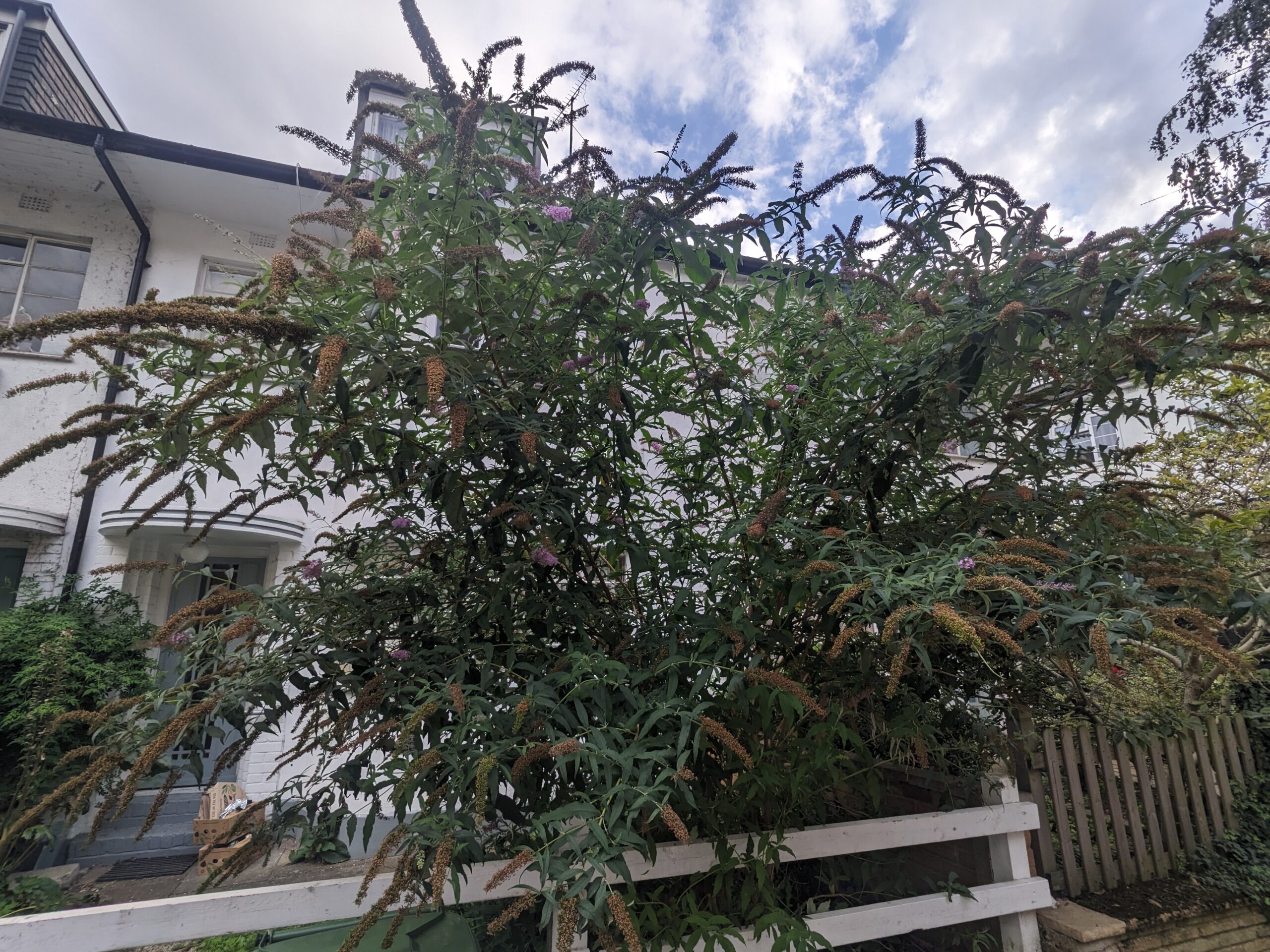
However, once you start noticing the Buddleja, you begin to see it everywhere. I would by lying if I claimed that it did not change my rosy perception of it. Although this runs counter to my avowed impulse to embrace weeds – that contradicts another desire to see diversity. You don’t want to see the same plants everywhere.

A tree in front of a building

AI-generated content may be incorrect.

Hampstead.

Notwithstanding that it is fascinating to see situations where, I don’t know for what reasons, these plants have grown to stupendous scale in the gardens of London. It may be that they were planted there but I think it’s more likely that they grew there, people thought they looked pretty, and that they were allowed to thrive. I think if the owners knew they were weeds (whatever your philosophy is there) they would cut them down. Leaving aside for the moment all questions of what the right or wrong thing to do in that situation is.

Taking the photo above two elderly women noticed me. It turned out that this was one of their houses. They greeted me a little quizzically. I did give a friendly hello as I scooted off on my bike, but it was still a not entirely comfortable situation. Perfectly legal to take photos of anything on the street of course…

A tree next to a fence

AI-generated content may be incorrect.

Belsize Park.

Here is a huge bush in the garden of a very grand house in Belsize Park…

A brick wall with trees and a building in the background

AI-generated content may be incorrect.

Chalk Farm.

Growing out of the back of a block of flats’ shared garden…

A purple flowers on a bush

AI-generated content may be incorrect.

Primrose Hill.

In the railway sidings at the back of Primrose Hill…

A plant next to a building

AI-generated content may be incorrect.

Islington.

A fence with plants and a sign

AI-generated content may be incorrect.

Old Street.

A pole with a flower on it

AI-generated content may be incorrect.

Old Street.

Around Old Street which is the arse end of Islington – Bunhill being the most densely populated ward in the UK apparently – I’m less surprised to see the Buddleja being cultivated in the parks around here. There’s a sense that no-one (least of all the council) gives a shit about the public space.

A train tracks next to a brick building with graffiti

AI-generated content may be incorrect.

In Croydon with its natural ally graffiti.

A train tracks and trees

AI-generated content may be incorrect.

Croydon.

Train tracks in the woods

AI-generated content may be incorrect.

Redhill.

It is now often seen there along railway lines and on the sites of derelict factories and other buildings. The plant frequently grew on urban bomb sites during the aftermath of World War II, earning it the nickname of “the bomb site plant”.

Wikipedia entry on the Buddleja davidii.

A garden with a tree and grass

AI-generated content may be incorrect.

Findhorn.

And finally even at the Findhorn Foundation, the garden of Eden itself. Its violet flowers now dead as the season is likely to be shorter outside Inverness.