13.9.23

Melon Climax

 A bee on a flower

AI-generated content may be incorrect.

Some proper pollination.

There was a groaning mailbag after my now legendary Epic Melon Fail post. Advice, recriminations, condolences, exhortations for me to not give up on my noble quest to grow Melons on Old Street. Thank you all. I felt showered, douched even, with the full spectrum of emotional response.

A fruit on a plant

AI-generated content may be incorrect.

Melon “Joe”.

A melon growing on a fence

AI-generated content may be incorrect.

Melons “Vlad” and “Kim”.

But good things come to those who wait. The plant decided that it really liked the heat, light and wind on the roof garden. I fed it with a dressing of compost and watered it dutifully through the summer. Mildewed plant fell away and a healthy new growth of leaves started up. Bees busied themselves pollinating the yellow flowers and I was stunned to discover, not one, but five melons grew.

Two are still on the plant but last night, in anticipation of the weather finally turning now that it is September, I made the leap and cut two specimens loose.

A hand holding a melon

AI-generated content may be incorrect.

Melon “Kim”.

A hand holding a melon

AI-generated content may be incorrect.

Melon “Vlad”.

Rules dictate that one has to wait for a melon to smell sweet before cutting it but I just went ahead anyway.

A melon cut in half with seeds on a cutting board next to a knife

AI-generated content may be incorrect.

Because I’m a generous soul I gave the larger melon “Kim” to Mrs. Ingram and Master Ingram to share. Miss Ingram doesn’t like melon. Apparently it was delicious.

5.9.23

Buddleja davidii

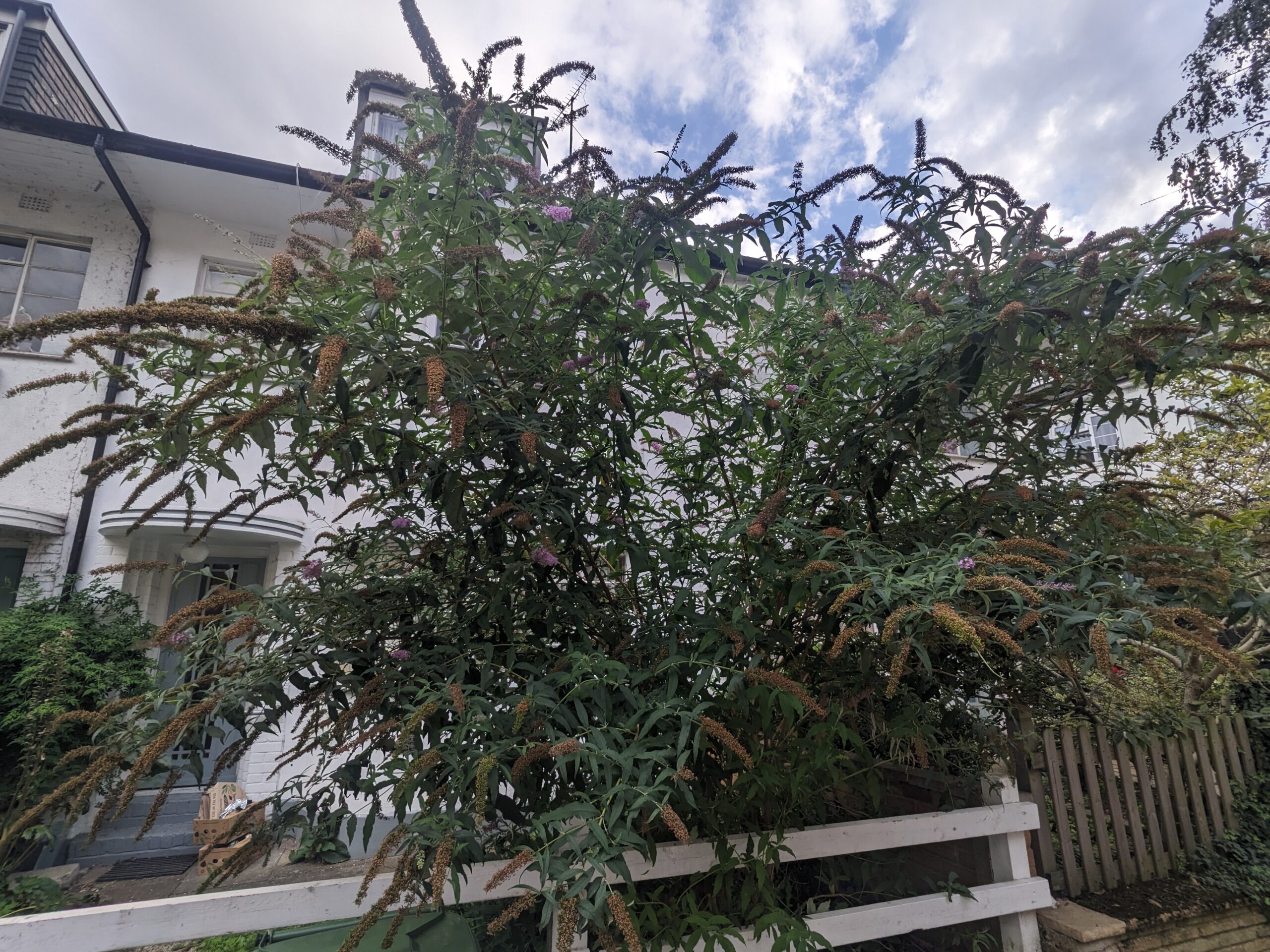
Buddleja, pronounced “buddly-ah” is an interesting plant. Sometimes called “Summer Lilac” it has grown in my awareness this season a great deal. That learning process itself has been interesting in the way it has emerged slowly from a zone of semantic indifference. A few months ago I was totally ignorant about it as I imagine most people who aren’t gardeners are.

It is native to the Sichuan and Hubei provinces in central China, and also Japan. The plant’s name was given to it by none other than Linnaeus, “the father of modern taxonomy” who named it after the English Botanist the Reverend Adam Buddle. With these oriental and religious overtones it is ripe material for this blog.

However, in the UK it was classed as an invasive species in 1922. It’s a weed. It’s simply too damn successful in our temperate region. Its long frondlike arms which wave around in our constant Atlantic winds spread their seeds like nobody’s business. And the plant itself seems capable of growing on next to no soil. I had to remove a Buddleja from the masonry of our back wall, and a huge plant a metre tall had been sustained by no more than a thimble of earth.

A plant in a pot outside of a building

AI-generated content may be incorrect.

My roof garden.

This Buddleja is in my roof garden. I had found it growing alongside another plant and planted it in this swanky grey pot without knowing what it was. I’ve encouraged many weeds in this way, the Dandelions I’ve written about before, my Ash tree etc.

A purple flower in a garden

AI-generated content may be incorrect.

Its flowers.

And the bees and bugs love it. It’s also known as a Butterfly bush for this reason. It looks very pretty I think!

A plant with purple flowers in front of a brick building

AI-generated content may be incorrect.

Round the back of Wormwood Scrubs.

However, once you start noticing the Buddleja, you begin to see it everywhere. I would by lying if I claimed that it did not change my rosy perception of it. Although this runs counter to my avowed impulse to embrace weeds – that contradicts another desire to see diversity. You don’t want to see the same plants everywhere.

A tree in front of a building

AI-generated content may be incorrect.

Hampstead.

Notwithstanding that it is fascinating to see situations where, I don’t know for what reasons, these plants have grown to stupendous scale in the gardens of London. It may be that they were planted there but I think it’s more likely that they grew there, people thought they looked pretty, and that they were allowed to thrive. I think if the owners knew they were weeds (whatever your philosophy is there) they would cut them down. Leaving aside for the moment all questions of what the right or wrong thing to do in that situation is.

Taking the photo above two elderly women noticed me. It turned out that this was one of their houses. They greeted me a little quizzically. I did give a friendly hello as I scooted off on my bike, but it was still a not entirely comfortable situation. Perfectly legal to take photos of anything on the street of course…

A tree next to a fence

AI-generated content may be incorrect.

Belsize Park.

Here is a huge bush in the garden of a very grand house in Belsize Park…

A brick wall with trees and a building in the background

AI-generated content may be incorrect.

Chalk Farm.

Growing out of the back of a block of flats’ shared garden…

A purple flowers on a bush

AI-generated content may be incorrect.

Primrose Hill.

In the railway sidings at the back of Primrose Hill…

A plant next to a building

AI-generated content may be incorrect.

Islington.

A fence with plants and a sign

AI-generated content may be incorrect.

Old Street.

A pole with a flower on it

AI-generated content may be incorrect.

Old Street.

Around Old Street which is the arse end of Islington – Bunhill being the most densely populated ward in the UK apparently – I’m less surprised to see the Buddleja being cultivated in the parks around here. There’s a sense that no-one (least of all the council) gives a shit about the public space.

A train tracks next to a brick building with graffiti

AI-generated content may be incorrect.

In Croydon with its natural ally graffiti.

A train tracks and trees

AI-generated content may be incorrect.

Croydon.

Train tracks in the woods

AI-generated content may be incorrect.

Redhill.

It is now often seen there along railway lines and on the sites of derelict factories and other buildings. The plant frequently grew on urban bomb sites during the aftermath of World War II, earning it the nickname of “the bomb site plant”.

Wikipedia entry on the Buddleja davidii.

A garden with a tree and grass

AI-generated content may be incorrect.

Findhorn.

And finally even at the Findhorn Foundation, the garden of Eden itself. Its violet flowers now dead as the season is likely to be shorter outside Inverness.

19.8.23

FarmEd

A road with a sign in the middle of a field

AI-generated content may be incorrect. 

Looking down from the entrance on the A361 down onto the FarmED buildings.

On 7th July I had an appointment in Gloucestershire at 9am in the morning. I’d had to rent a car to get down there in time, so I was faced with the possibility of either heading straight back to London, or trying to find something else to do that day to get some value from my journey. Purely by chance I was scanning through my mailing list folder and found a message from FarmED saying that they were giving a walking tour that very day.

Set up by Ian and Celene Wilkinson at Honeydale Farm in Oxfordshire, FarmED is a demonstration farm created to explore and promote regenerative agriculture. Ian’s background was as the director of Cotswold Seeds, a company which made its reputation developing cover crops to restore soil fertility. Celene, a veterinary nurse by training, has expertise in matters of health as they relate to diet in both people and animals. FarmED have trial fields, host events and seminars, have a restaurant which cooks their own produce, run a profitable market garden, shelter a small dairy, and even produce their own honey. It could be considered “meta” farm.

Honeydale Farm’s location is right next door to Diddly Squat and Kingham, “meta” farms in their own right. However, unlike neighboring Jeremy Clarkson and Alex James, the Wilkinsons don’t have access to unlimited capital.

Is a “meta” farm less valuable than a “real” farm? My view is that farming (and especially organic, biodynamic and regenerative farming) needs advocates. Part of the problem with the urban/rural disconnect, and with it our alienation from the sources of our food, is the absence of dialogue to connect farming with contemporary culture and values. FarmED fills that gap convincingly. Its relatively low agricultural productivity is more than compensated for by its educational services to farming. It’s the same yardstick by which I would judge my own extremely humble efforts.

A wooden building with a door open

AI-generated content may be incorrect.

Collection point for the FarmED CSA scheme.

A sign in a field of plants

AI-generated content may be incorrect.

Rewilded.

Right away I noticed that the farm’s architecture differed drastically from the farms I knew in my childhood with their massive drafty, steel barns and never-ending concrete yards. They are, frankly, very chic. Furthermore, every spare space between the buildings was allowed to grow wildly, if sometimes augmented by carefully sown wild flowers.

A shelf with books and a television

AI-generated content may be incorrect.

The FarmED library.

As we were gathered together in the meeting I room I had the opportunity to marvel at FarmED’s incredible library of classic books on the subject. This is the kind of intellectual heft I delight I seeing behind farming.

A person holding a painting

AI-generated content may be incorrect.

Ian Wilkinson.

Ian Wilkinson gave our group an introductory talk explaining how he came across the farm, and negotiated the perils of its mortgage, so as to bring the couple’s dream to life. I definitely got the sense that this was a risky undertaking. The farm also employs a staggering 34 people which must make for a steep wage bill.

Ian passed us over deftly to the brilliant Kate Henderson, who he took great pride in informing us was the granddaughter of farming legend George Henderson. George’s classic book “The Farming Ladder” has been feted by none other than Eliot Coleman and Joel Salatin. Kate got the job as a result of showing up one day in her car with a box of the books, enquiring if the Wilkinsons had any use for them.

Interestingly its publisher Faber, through the efforts of Richard De La Mare, historically editor of the firm’s agriculture and horticulture lists, was a stalwart supporter of the organic cause putting out such notable titles as Eve Balfour’s “The Living Soil” and Ehrenfried Pfeiffer’s “The Earth’s Face”. Faber even republished Darwin’s study of the earthworm. In recent years I associate the imprint mainly with books on music.

A book on a table

AI-generated content may be incorrect.A group of people standing in a field

AI-generated content may be incorrect.

Kate Henderson.

Our initial port of call was the first of two trial wheat fields. This one sown with Crusoe milling wheat. Crusoe is a modern “chemical agriculture” wheat which has been bred with short, stubby, strong stalks. These are able to bear the weight of its massive head of grain which has been designed to convert as much of the 170kg of synthetic fertiliser applied to the control plot as possible.

The use of chemical fertiliser to run this ongoing trial is one of the reasons why Honeydale Farm is not certified organic. Any use of fertiliser on the entire site would disqualify them. FarmED’s stated reason for not certifying, however, is that they need to be relevant to all farmers within any specific scheme. The chemical field is also sprayed with a litre of the herbicide Glyphosate.

Kate brought a spade and dug out a clod of earth which we were invited to feel, crumble and smell. I would lying if I claimed to notice much difference between the two plot’s soil based on just these physical characteristics. In fact I was expecting the difference to be greater. There was only a very faintly brackish odour to this, the first.

A hand holding a small pile of dirt

AI-generated content may be incorrect.

Chemical soil.

A group of people standing in a field

AI-generated content may be incorrect.

Our group.

Now, on this our march, I took the opportunity to size up the rest of the group. It had a truly remarkable profile with people hailing from diverse fields of expertise. There was Daisy Wood and a colleague from LEAF; Dr. Sarah Watkinson an Emeritus Research Fellow in Fungal Biology from Oxford University; Elizabeth, a farmer from nearby Coln Rogers with two of her colleagues; Celia Leverton a regenerative farmer and travelling scholar on a Churchill Fellowship from Tasmania, and Richard Buckley from Bath and his family (who run an acclaimed vegan restaurant Oak) along with their affiliated grower Georgia. The very tall man was a computer scientist from Boston, USA who was perhaps arriving at the field from the same angle as me. How that angle should be characterised I leave to you, dear reader.

A field of green plants

AI-generated content may be incorrect.

The winter bird seed field.

Sandwiched between the two fields, and separating them as it were, was a field dedicated to growing seed which the birds could eat in the winter. Apparently they love it.

A field of wheat with trees in the background

AI-generated content may be incorrect.

Heritage wheat.

While the conventional field reached Kate’s waist, the heritage wheat field came up to her shoulders. FarmED are this year growing the varieties Emmer and Einkorn – seeds which, unlike the Crusoe, nobody owns the rights to, and which had been provided to them by local farmers.

Right away you can understand why Norman Borlaug and his team set their sights on breeding the Green Revolutions’ characteristic short rigid stems. One heavy rainstorm or gale could flatten the entire field and ruin a crop. It ripples very appealingly in the breeze. Beneath the canopy of the heads of grain is sown clover which not only, as a legume, fixes nitrogen in the soil, but also keeps its temperature down and moisture up.

A hand holding dirt in the palm of a hand

AI-generated content may be incorrect.

Soil.

Kate invited us to pick at another clod she had dug, and this time I found a friendly worm; others also found worms in the chunks they picked off. Apparently below 4 worms per sample (spadeful) indicates poor soil, and above 8 worms is good. A healthy earthworm population is calculated as being about 250 worms per square metre. Certainly there were none in the chemical plot.

A group of people walking through a field

AI-generated content may be incorrect.

Kate regaled us with some statistics, however, which put some perspective on our gathering ecological delight.

The heritage wheat field yielded 50% of the grain that the chemical field did. Although I was prepared to overlook the difference in the gluten levels between the heritage (12%) and chemical (28%), modern bakers want higher levels of gluten which give a more buoyant loaf. Of course, the gluten-free lobby argues that these “unnaturally” high levels of gluten have unleashed a plague of inflammatory symptoms in society. Slightly more troubling was that the heritage wheat had lower amounts of protein (9.78%) vs the chemical wheat’s (12.83%).

As much as I dislike modern wheat, in fact I don’t eat it, the arguments in its favour are in some respects convincing. This is even if you take the view that its relative cheapness is complicated by the cost of inputs (fertilizer and herbicide), the hidden cost of its associated environmental damage (soil erosion, biological harm etc), and, as is alleged, its poor flavour.

A group of sheep in a field

AI-generated content may be incorrect.

Sheep.

A group of people standing in a field

AI-generated content may be incorrect.

As we carried on our Magical Mystery Tour we encountered a man who was running a controlled experiment in the next top field. He had sunk two pipes into the soil – one open at the sides – one closed all the way down – and was measuring CO2 output atop both.

His hypothesis here was that the mycorrhizal fungi which, in theory, will have penetrated the sides of the open pipe, would affect the respective carbon dioxide emissions issuing into the atmosphere. Presumably better mycorrhizal integration would mean a lower carbon output, as these rhizomes are believed to draw from the soil and distribute?

A hand touching a portable radio

AI-generated content may be incorrect.

The very impressive meter.

A person holding a flashlight and a lamp in a field

AI-generated content may be incorrect.

Our man demonstrating the technology.

A person holding a device

AI-generated content may be incorrect.

The sensor giving a reading of the ambient CO2 levels.

A person holding a device

AI-generated content may be incorrect.

When our man breathed into the sensor the levels shot up.

A person standing in front of a greenhouse

AI-generated content may be incorrect.

The final field along the top contains the market garden’s poly tunnels. I absolutely love poly tunnels and also green houses. If I had a green house I believe I would probably die of happiness. These are managed by the growers Dan Betterton and Emma Mills for the organisation Kitchen Garden People who run the CSA. The Kitchen Garden People Community Supported Agriculture (CSA) scheme organises 130 veg boxes which are collected from the site every week. Very heroically they even produce veg in the “hungry gap”, a hard time for the UK’s farmers which occurs in April, May and early June, after the winter crops have been used up and before the new season’s plantings are ready to harvest.

A group of people in a field

AI-generated content may be incorrect.

This year, for the first time, the growers employed a no-dig strategy. In their case, on this medium scale, they sow a green manure, leave it in the ground for one to two years, before eventually allowing it to break down under tarpaulins.

There are many ecological arguments being put forward these days for the positive benefits for soil health through not digging. Unfortunately, in a number of cases this has mean that powerful chemical agriculture conglomerates like Syngenta have begun to argue, I believe speciously, that with no-till (no-dig) methods regenerative agriculture is compatible with the use of herbicides like Glyphosate. This is a kick in the teeth for those claiming that what is known as organic agriculture (very broadly no chemical fertilisers, herbicides and pesticides) is the path to truly regenerative, and ecological farming.

This picture is further complicated by the fact that many organic growing practices, which accommodate massive monocultures, organic fertilisers (as opposed to the use of compost and leys), and ploughing, are seen as ecologically damaging. I understand that currently the UK’s Soil Association is seeking to remedy this with a Organic Regen label. Elsewhere at Honeydale farm they have a policy of tilling only the top 3-4 inches. This is generally accepted as being much less disruptive.

A person standing in a greenhouse

AI-generated content may be incorrect.

The automated temperature-controlled door panel swung open bisects this photo.

Our group was full of admiration for how the temperature within the poly tunnels was controlled by automated doors and by the irrigation system in evidence. A number of us were intrigued by the growers’ “chop-and-drop” policy which is evident in the stems visibly strewn on the ground. This is a very efficient way to compost, you just let the unused vegetable matter decay right there on the soil rather than wheeling it away to a compost pile, only to then have to wheel it back once it has decomposed. However, some vegetable gardeners argue that “chop-and-drop” increases the numbers of slugs, snails and other pests. It seems there’s often a case to be made for these alternative methods.

Water is not exactly abundant on the site. It’s frugally collected off the building’s rooves and also from a spring on the land. Last summer the team had resort to using the mains during the drought and so this year there are discussions about the possibility of drilling a borehole. I know from experience that this is costly business, and where they are, on top of a hill, they’d probably have to dig deep to reach the water table. Needs must.

A tree stumps in a grassy area

AI-generated content may be incorrect.

The bees at Honeydale Farm, are looked after by what FarmED rather wittily call The “B” Team. I was fascinated to see that the hives are installed into tree stumps. Interestingly the honey is used as much for a skincare range as for food.

A group of people walking in a field

AI-generated content may be incorrect.

Then we walked down the hill on what was truly a most glorious day.

A group of people standing in a grassy area

AI-generated content may be incorrect.

Where, at its foot, we admired the series of drainage ponds.

The walking tour was such a fascinating experience in exquisite scenery alive with nature. Fortuitously the weather was beautiful (it wouldn’t have mattered of course…) and my fellow students were an amazing, multifaceted bunch. As the glow of the summer has begun to fade it makes me misty eyed to think back to it now.

Many thanks to Ian and Kate.

16.7.23

Moki Cherry

 The ICA are holding a wonderful exhibition of the work of Moki Cherry which closes on Sunday 3rd September 2023. This has been co-curated by her granddaughter Naima Karlsson. The exhibition especially benefits from being seen in the flesh. I went along with my old pal Sacha.

A picture of an octopus

AI-generated content may be incorrect.A painting on a wall

AI-generated content may be incorrect.A painting on a wall

AI-generated content may be incorrect.

The mood of these works is playfully organic. Although Moki was a skilled pattern cutter, free reign is given to her enchanting child-like style. In that sense the work is of a kin with her husband the musician Don Cherry’s own naturally unfettered improvisation, itself rarely abrasive or ugly, often straying back and forth between comforting jazz tropes and extemporised flights into freedom. I swear I hear a lot of Vince Guaraldi (via the Snoopy soundtracks) in Don’s piano work.

A painting on a wall

AI-generated content may be incorrect.A white and orange envelope with a heart and arrow

AI-generated content may be incorrect.A black and white cloth with a skull and bones on it

AI-generated content may be incorrect.Two paintings on a wall

AI-generated content may be incorrect.A cloth with a person with a face on it

AI-generated content may be incorrect.

I couldn’t resist posing under this tapestry which was used on the actually not-so-great “Hear & Now” LP. Funnily enough this LP also cropped up in the relatively recent Tantra exhibition at the British Museum.

A person standing in front of a large banner

AI-generated content may be incorrect.A colorful fabric arch with a blue and yellow border

AI-generated content may be incorrect.A person sitting in a lotus pose

AI-generated content may be incorrect.A quilt with text on it

AI-generated content may be incorrect.A colorful artwork on a white surface

AI-generated content may be incorrect.A cover of a album

AI-generated content may be incorrect.A close-up of a banner

AI-generated content may be incorrect.A blue and purple fabric with a red ribbon

AI-generated content may be incorrect.

Moki’s beautiful tapestries were, for a number of years, fixtures on Don’s albums covers. We wondered, rather sadly, what happened to the relationship between Don and Moki in the end.

If you have time please watch this vintage documentary to get the feeling of their life together in Sweden. I used a small excerpt from it, of the team all reciting the Om Mani Padme Hum mantra, in one of my Retreat videos.

A painting of a person's head

AI-generated content may be incorrect.A large piece of art on a wall

AI-generated content may be incorrect.A colorful fabric art piece

AI-generated content may be incorrect.A large banner from a ceiling

AI-generated content may be incorrect.A paper with writing on it

AI-generated content may be incorrect.

An exquisite drawing. There’s much evidence of both their fascination with Indian music. He wasn’t one of the main disciples, but Don was a student of Pandit Pran Nath’s at one point. Moki herself played Tambura pictured here.

A bag with a patchwork pattern on it

AI-generated content may be incorrect.

Again with the Tibetan Buddhism. Tara, or Green Tara, is alongside Chenrezig the key Tibetan deity. Tibetan men identify with Chenrezig, the women with Tara.

Moki is a perfect figure for today’s revision of female artists. Equality here means just that; equality between different races, genders, even generations.

A painting of a person with a face on it

AI-generated content may be incorrect.A tv on a cart

AI-generated content may be incorrect.

Some of Moki’s videos were playing on a loop. Here’s a fleeting shot of her Chenrezig tapestry.

A colorful fabric on a wall

AI-generated content may be incorrect.A mirror with a person taking a picture

AI-generated content may be incorrect.A drawing of a cartoon

AI-generated content may be incorrect.A painting on a glass surface

AI-generated content may be incorrect.A colorful curtain in a room

AI-generated content may be incorrect.

Later the same evening that I visited there was a concert by the improvisor and percussionist Kahil El’Zabar. El’Zabar’s background was with the Chicago organisation AACM. The hall was decked with Moki’s tapestries.

A curtain with a flower and birds on it

AI-generated content may be incorrect.A stage with a group of people sitting on it

AI-generated content may be incorrect.A group of people on a stage

AI-generated content may be incorrect.A group of people on a stage

AI-generated content may be incorrect.A group of people on a stage

AI-generated content may be incorrect.

This was an excellent concert. Kahil El’Zabar conducted the “orchestra” – by sonic queues and gestures, guiding what was more a free-ranging groove than the skronk traditionally associated with improvisation. In some sections it reminded me of CAN at their quietest and most rapturous. It was a thrill to see Neneh Cherry providing background vocals, the whole exhibition and concert somehow having a family feel. It was as though the whole diverse audience were being welcomed into their Cherry family. Thank you, Naima. Thank you, Moki.