31.3.25

Addicted to Humus

Article for The Quietus

Addicted to Humus: Matthew Ingram on the Revolutionary Potential of Compost


Matthew Ingram, aka Woebot, is an author and researcher in countercultural history. He found his way into a wider study of countercultural activity from a start as a music journalist covering domestic avant-garde scenes like Jungle and Grime. His first major book, Retreat: How The Counterculture Invented Wellness (2020) looked at health methodologies like Transcendental Meditation, LSD psychiatry, and macrobiotic food.

Its sequel is another first-of-its-kind investigation into the generation that took LSD, went back-to-the-land, grew organic food, and pored over The Secret Life Of Plants. His book, The Garden: Visionary Growers And Farmers Of The Counterculture, is published in April, and looks at how with phenomena such as permaculture, the natural farming of Masanobu Fukuoka, and deep ecology, the counterculture set the template for the sustainable agriculture of today.

Ingram is, like many recent converts to the horticultural arts, a keen gardener. However, it’s compost itself and the dark arts of making soil which has caught his imagination, as much as growing itself.

My journey into compost
Gardening is a voyage of discovery. Once I had nailed growing seeds into seedlings, and had successfully planted them out in a raised bed, I looked around to see what else I could try my hand at. Shop-bought compost, the good stuff like Dalefoot, Moorland Gold, or Carbon Gold, is very high quality but expensive. So rather than waste material from the garden or kitchen, it’s thriftier, and frankly more fun and interesting, to turn it into a useful growing medium.

Composting 101
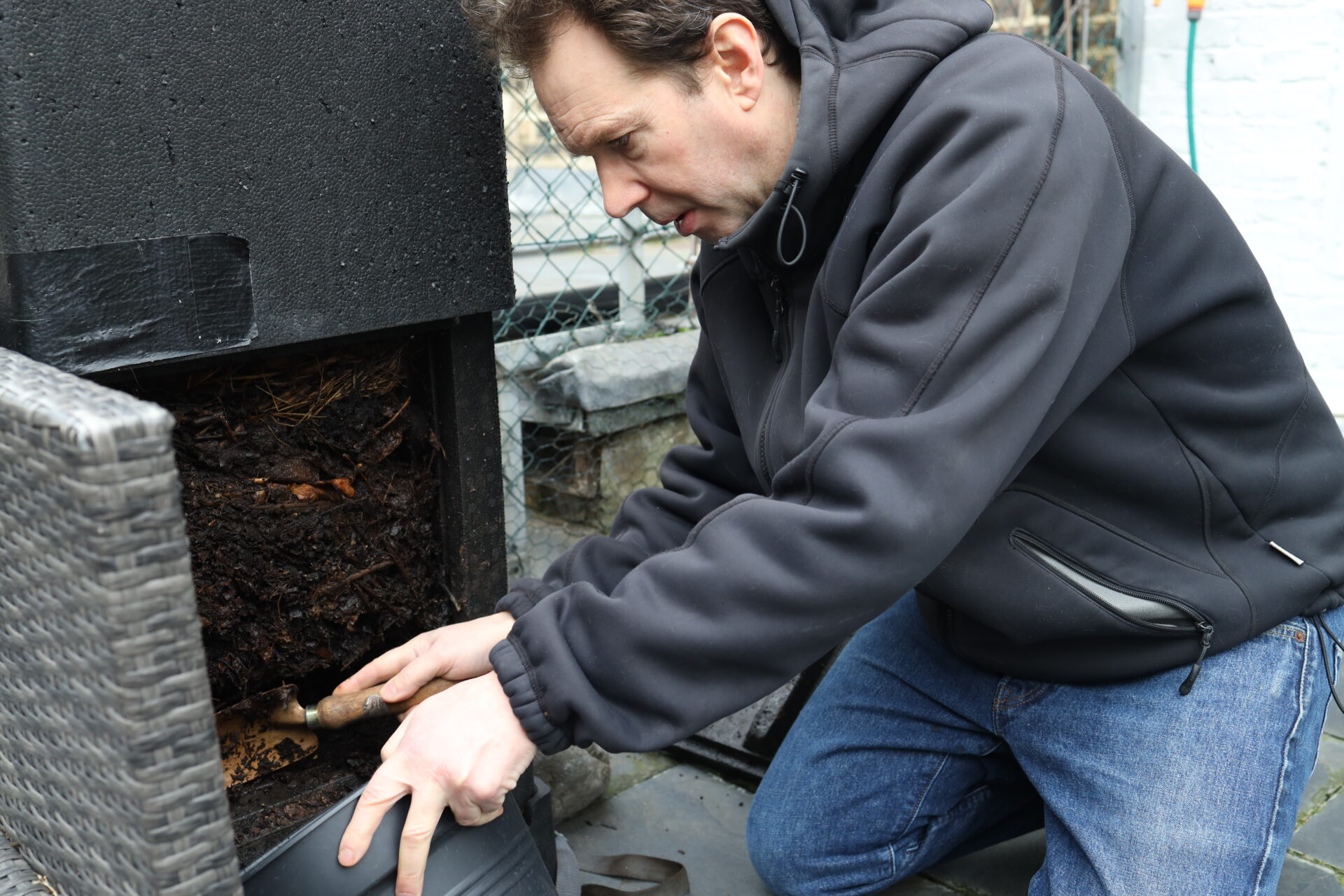
Whenever I think of compost my mind wanders to The Fast Show and its character “coughing” Bob Fleming and his “Country Matters” spot. But compost is a deadly serious business. I started doing it on my urban roof terrace in 2023. In layers you combine “green” matter rich in Nitrogen (not technically green this can be uncooked vegetables and any fresh garden waste) with “brown” matter rich in Carbon (fine woodchip, shredded cardboard, and paper). In the presence of oxygen, thanks to the action of bacteria, in its thermophilic stage the temperature soars, and the heap (in my case a Hot Bin) steams like an ocean liner. Composting does actually give off Carbon Dioxide, but see it as a net positive process, at the end you are left with a dark rich humus which is an ecologically valuable suppository of stable carbon. The simple trick to identifying the presence of carbon in soils, typically a residue of decayed organic matter, is the soil’s darkness. If soil, a field for instance, looks black or dark brown then it will contain a high amount of carbon, possess a high fertility, and be alive with healthy microorganisms.

Compost in history
Researching my book The Garden I ended up learning a lot about the history of compost. The process is mentioned as far back as the Roman Cato the Elder’s “De Agri Cultura” in 160 BC. However, with the increasing reliance upon first guano, seagull shit from the desert coastline of Peru in the 19th century, rich in macronutrients which are rocket fuel for plant growth – and then subsequently the widespread agricultural use of Sulfate of Ammonia created in the Haber-Bosch process, mainstream growers and farmers seemed to forget about the value of applying organic matter to the soil. Whether it was properly composted animal manure or made from agricultural waste and applied to the fields, the resulting soil, the plants themselves, and the environment are healthier than when doused with chemicals. Britain’s organic movement with its luminaries, the swashbuckling Lady Eve Balfour and implacable foe of “the NPK mentality” Sir Albert Howard, put compost at the centre of their rebellious opposition to Industrial agriculture. Howard’s Indore method, devised in collaboration and under the watchful eye of Indian farmers, produced what might be seen as the “haute couture” of compost – even if not regularly used by organic farmers in the UK the Indore method was a valuable organisational principle for the organic movement.

Composting in the Inner-city
I didn’t expect that my composting would smell and upset my neighbours. However, without enough circulating air the process turns anaerobic and does create a pong. One has to be sure that sufficient oxygen is penetrating the pile, to which end last year I drilled holes in a copper plumbing pipe and plunged it through the stack. That did the trick. The only persistent pest is not rats (that’s why one shouldn’t be in a hurry to compost scraps of meat or cooked food) – but our black cat Kiki who positions herself on the bin’s top, now having clawed its sides to shreds. No matter, it still works, and the resulting compost has produced many fine crops like these my winter brassicas.

 
The fine art of composting
I wish I could pretend to be a master composter. I visited the legendary Charles Dowding at his Homeacres garden in Somerset in 2022 and marvelled at the quality of what he is able to produce in his huge, roofed bays from an abundant supply of garden waste. Compost, and its application as a surface mulch, spread like marmite on a slice of toast, works brilliantly in a no dig system. Not digging the soil preserves its natural structure, doesn’t disturb soil microorganisms, and keeps the fine threads of mycorrhizal fungi intact. Composting at this rarefied level takes on a Vedic, cosmic dimension as a dramatisation of the cycle of life.

Compost as a process in culture
I came to gardening from a background of music. And there are unmistakable connections between the practices. The mix, like the creation of a good compost heap, requires carefully-selected ingredients – and only when everything is in the right balance will the alchemy occur. As WOEBOT I composed a number of sample-based EPs and LPs – highlights being Moanad (2010) and Chunks (2011). These were made from the discarded remnants of seventies rock, whereas now I’m working with weeds, kale stalks, and the brown-paper packaging from deliveries.

Compost as our salvation
I’ve mentioned compost’s high seriousness. And, truthfully, its ecological importance can’t be underestimated. We throw away, as though it were rubbish, a truly disgraceful amount of organic matter. It is piled up in municipal rubbish heaps, burnt, or in the case of our “humanure” flushed out to sea. The Chinese civilisation, the “Farmers of Forty Centuries” that Professor F.H. King studied in his landmark book of 1911 would have been appalled by our neglect of this valuable resource. We forget at our peril that the soil which grows all our food is a precious and rapidly diminishing resource.

20.3.25

Hands on the Land

Article for WWOOF

Writing in a postscript to his classic book “The Fat of the Land” in 1974, self-sufficiency guru John Seymour proposed of his smallholding at Fachongle Isaf, “If there were enough people on it — enough hands — I believe that our seventy acres could produce a dozen times as much food as it did before.”

Quite soon after this, in defiance of his wife Sally who had previously urged him “Oh no – we don’t want to start some bloody community!” Seymour had drawn in young back-to-the-landers to live with them in Wales and help. Ann assumes the role of foreman, Paul takes over the pigs, Anushka drifts into looking after the dairy, and Eddie (a vegetarian) takes over the house gardens. Seymour himself notes “…somehow everybody crawls out of bed very early in the morning for the milking (except me – I meditate – in a horizontal position).” Perhaps he was scheming, as he was wont, on the imminent future? As he writes, “We must start preparing now for the collapse of the technocracy. We must build the framework now that will be ready to receive the people who will one day flee from the decaying cities and clamour for their birthright — their fair share of their own country.”

That catastrophe hasn’t happened yet, thank goodness, but if we heed the warning of author Chris Smaje in “A Small Farm Future” (2020), just as John Seymour advocated fifty years ago, a robust response to both climate change and food security lies in downscaling industrial agriculture and its massive monocultures to smaller “mixed” farms. To increase yield in those circumstances, as Seymour explains, goes hand-in-hand with the need for more skilled agricultural workers. The techniques of industrial agriculture have meant that, by the combination of heavy machinery and prodigious use of chemical fertilisers, very little labour is required. A single farmer can often manage 1,000 acres on his own. But at what cost to our ecology, nutrition, social cohesion, and sanity?

Genuinely free-range chickens on Sustainable Food Trust supremo Patrick Holden’s farm

It was this situation into which the WWOOF organisation first germinated. In an interview for SEED magazine, Sue Coppard noted of organic farms, “it occurred to me—correctly—that such places might be more inclined to use unskilled labor than a big, commercial farm.” Patrick Rivers, another once well-known self-sufficiency advocate, and contemporary of John Seymour’s, writes in his book, “Living on a little land” (1978): “Some years ago a lass called Sue Coppard started a small revolution. Sue wanted to escape the restrictive boredom of weekends in the city, not merely to flop, but to balance the work of her head with the work of her hands.” Rivers described of his own smallholding how he and his wife Shirley, “…could never have achieved what we have without the help of scores of “WWOOFers” who have come to us – most of them for weekends, some for stretches of several weeks… I can recall none who have not shared our views on living more simply, and on the need to bring about a gentle revolution by setting an example.”

For the past few years, I have been writing and researching a book entitled “The Garden: Visionary Growers and Farmers of the Counterculture” [see below] For the book I interviewed many first-generation farmers who, inspired by their experiences at the end of the sixties, went back to the land to farm. The likes of Eliot Coleman, Sustainable Trust supremo Patrick Holden, and Permaculture co-originator David Holmgren, like many of the willing workers of WWOOF, did not come from the countryside or farming families. One and all responded to an impulse to get out in nature and work the soil.

One of my interviewees, another veteran of the back-to-the-land movement, Dave Chapman of America’s Real Organic Project noted, “The other thing… is that when I did start to farm — and I was gardening before I was farming — I loved it. I loved the smell of the soil. I love working in that way with my body. I loved watching plants grow. It was all pretty much, you know, as they say, as much fun as you could have with your clothes on.” Certainly, there was less money to be made, but as John Seymour described his own rural labour, in a possibly exaggerated way, “If I were to work in an advertising agency I would want my labour to be assessed not at ten shillings or a pound an hour, but at a million pounds an hour.”

Patrick Rivers adds that, “Besides helping both farmer and learner, WWOOF plays a small but valuable role in bridging the gap between city and countryside and reviving interest in the land.” This connection which WWOOF offers people living in the cities to the land is even more precious to us today in 2025. The gap Rivers refers to is now more like a chasm. In 1962 the American theorist Murray Bookchin could write, “The city man, to be sure, does not need to be reminded that good soil is important for successful farming. He recognises the necessity for conservation and careful management of the land. But his knowledge of food cultivation — its techniques, problems, and prospects — is limited.” Today it is only possible to imagine a mere fraction of city dwellers having even this awareness. The thoroughly misguided institution, and the recent collapse of the urban hydroponic infrastructure [watch a video about this here] plainly unsustainable to anyone with even a rudimentary understanding of vegetable production – clearly reveals how little understanding of the precepts to which Bookchin refers to are grasped by city dwellers.

I came away from writing the book “The Garden” with a feeling that the encouragement of people living in cities to understand the importance, the sanctity even, of organic food production is vital for the future of sustainable agriculture. Yes, in the best case scenario, that would involve people volunteering for WWOOF and actively participating – but equally, as was advised by pioneering organic scientist Sir Albert Howard, urbanites such as myself can do our bit by buying organic food, and gardening organically, if only on our window-ledges.

Well, we hope you enjoyed reading this article by Matthew Ingram. His book The Garden comes out on 8th April and has some really good endorsements; here’s one by Charles Dowding (author of No Dig) “Matthew Ingram has not only investigated a huge amount of material and talked to many people, he also has an ability to bring it all together in a way that makes sense and is fun to read.” 


7.3.25

Unpublished Essay for the Soil Association

 The Organic Counterculture

It seems like everybody wants to be the “real” rebel these days, ever since the idea of alternative culture proved to be the hottest-selling ticket in town. Did that process start with the rock group Nirvana’s “Nevermind” album, Apple’s “Think Different” advertising campaign, or the advent of social media platforms like “X”? Organic farmers and merchants must have thought they were safe. Who could possibly connive to topple them from their perch as the righteously definitive opposition to industrial agriculture?

However, amid the barrage of PR funded by the bottomless pockets of chemical manufacturers, the as yet unregulated claims of regenerative agriculture, and now the proclamations of precision fermentation, the voices of what farmer Eliot Coleman calls “biological” agriculture have become harder to hear amidst the din. In the United States the organic standard has become dangerously eroded. USDA Organic regulations have been bent so far out of shape that both hydroponic growing and Concentrated Animal Feeding Operations now qualify. America’s Real Organic Project was set up in 2018 and provides an add-on label to the USDA Organic standard, to provide a corrective in line with the organic pioneers’ vision. Were it not for the rude health of the Soil Association, Lady Eve Balfour would be turning in her grave.

Amid these claims and counter-claims it becomes hard to chart the way forward for sustainably biological farming, to appreciate what we already have in the Soil Association. I’m the author of “The Garden: Visionary growers and Farmers of the Counterculture” (2025) and it’s my contention that to discover the true rebel spirit opposing industrial agriculture, we need to turn to the hippies. Writing the prequel to “The Garden”, a book titled “Retreat: How the Counterculture Invented Wellness” (2020) in February 2018 I had interviewed former Soil Association chairman and biochar pioneer Craig Sams about Macrobiotic food. The diet was described playfully as “kosher for hippies”. When we spoke, Sams had repeatedly referred to the soil’s role in promoting good health. In the first instance I was baffled – but over time I came to understand this logic, fundamental to the organic movement, and grasp how the hippies with their ethos of natural living felt a connection to ideas of the living soil.

However, when it came to the question of the hard graft involved in farming, with the legendarily “relaxed” hippies immediately there was a glaring issue. One of my interviewees, alone in electing to remain anonymous, reported the story of a Biodynamic colleague who was looking for someone to take on his farm, “He said, I don't want a poet. Properly doing agriculture is a path and it's not about wistfulness. It's not about “Ooh isn't that nice!” It's about getting up at four in the morning and going to bed at eleven o'clock at night… But at the same time, it takes a huge amount of focus, attention and energy.” As agricultural theorist Wendell Berry put it to Mother Earth News in March 1976, of the more feckless members of the counterculture, “I have a lot of enthusiasm, but I know how far it will get me. It doesn’t last until dark when you’ve got a full day’s work, or three or four days’ work, to do in a day. If you get all the way to dark and to the end of the job, then you’re going to be operating on something else.” Nevertheless, in spite of the movement’s reputation for impractical idealism, it might come as a surprise that the hippies that went into growing and farming turned out to be both obstinate and unsentimental.

Perhaps hippie farmers of that generation aren’t as numerous as they might be? Michael O’Gorman, who ran farming at guru Stephen Gaskin’s mega-commune “The Farm”, where at its high point he fed 1,500 people, lamented, “I think of all the dozens and dozens if not hundreds of people that I knew that were all going to be farmers, and at that time thought they'd be farmers for the rest of their life. The only two people I knew out of that period of my life that stayed with it were myself and my brother.” But by some quirk of fate, former hippies of the back-to-the-land generation ended up being some of the most influential figures in the organic movement. This including O’Gorman himself, who built three of North America’s largest and most influential organic vegetable farms and then went on to found the remarkable Farmer Veteran Coalition, where, to paraphrase Isiah 2:3, they literally beat swords into ploughshares.

I also had the honour of speaking to hippie giants such as Sustainable Food Trust supremo, Biodynamic patron, and former Soil Association director Patrick Holden. I sat round the kitchen table with America’s legendary and innovative grower, Eliot Coleman who proudly describes himself as “an old hippie,” and was regaled with countercultural tales by the co-originator of Permaculture David Holmgren. It seemed as though that, if “enthusiasm” wasn’t the vital ingredient the hippies availed themselves of, they drew durable ideological sustenance from the higher ethics which the counterculture promoted.

The appeal to the hippie generation of the Organic movement was, according to Gurney Norman writing in the hippie bible The Whole Earth Catalog in the early seventies that, “The whole organic movement is exquisitely subversive. I believe that organic gardeners are in the forefront of a serious effort to save the world by changing man's orientation to it, to move away from the collective, centrist, super-industrial state, toward a simpler, realer, one-to-one relationship with the earth itself.” Heeding President Eisenhower’s farewell address of 1961, with its ominous warnings of a “military-industrial complex”, the counterculture saw connections between the war in Vietnam and Dow and Monsanto, agricultural herbicide manufacturers, who acted under instruction from the U.S. government to produce Agent Orange. The herbicide, containing a chemical called dioxin, defoliated millions of acres of forests and farmland in Vietnam. The Vietnamese government says up to 3 million of its 84 million people have birth defects or other health problems related to dioxin. There seemed no better way to stand up to corporate America than in going organic, as farmer Jake Guest put it in an interview with the Real Organic project’s Dave Chapman. Of the small farms that disappeared, “They were taken over by the big corporations who took over the food industry. It was all connected, Vietnam, corporate America — these are not nice corporations.” Guest decided that it was a “no-brainer” that they grow their own food, and taught himself from books, the Rodale tomes, but also noted, “The British have a whole bunch of practical farming books… they tell you exactly how to plough a field…”

The British, especially Lady Eve Balfour and Sir Albert Howard took on legendary standing in America. Howard’s writing was inspirational to J.I. Rodale. Mildred Loomis, referred to as “the grandmother of the counterculture” because of her innovations in intentional communes, reports Rodale’s comments upon discovering Howard’s writing in Ralph Borsodi’s library, “The impact on me was terrific! I decided we must get a farm at once and raise as much of our family’s food by organic methods as soon as possible.” Eliot Coleman described meeting Balfour herself at an evening arranged by the Soil Association at a pub in London. After the encounter, one of Coleman’s group, a hardcore old leftist, turned to him, ““Damn,” he said, “If that's the aristocracy I think there should be more of them!” He was so impressed. And so was everybody else. She was just incredible.”