Buddleja, pronounced “buddly-ah” is an interesting plant.
Sometimes called “Summer Lilac” it has grown in my awareness this season a
great deal. That learning process itself has been interesting in the way it has
emerged slowly from a zone of semantic indifference. A few months ago I was
totally ignorant about it as I imagine most people who aren’t gardeners are.
It is native to the Sichuan and Hubei provinces in central
China, and also Japan. The plant’s name was given to it by none other than
Linnaeus, “the father of
modern taxonomy” who named it after the English Botanist the Reverend Adam
Buddle. With these oriental and religious overtones it is ripe material for
this blog.
However, in the UK it was classed as an invasive species in
1922. It’s a weed. It’s simply too damn successful in our temperate region. Its
long frondlike arms which wave around in our constant Atlantic winds spread
their seeds like nobody’s business. And the plant itself seems capable of
growing on next to no soil. I had to remove a Buddleja from the masonry of our
back wall, and a huge plant a metre tall had been sustained by no more than a
thimble of earth.

My roof garden.
This Buddleja is in my roof garden. I had found it growing
alongside another plant and planted it in this swanky grey pot without knowing
what it was. I’ve encouraged many weeds in this way, the Dandelions I’ve written about
before, my Ash tree etc.

Its flowers.
And the bees and bugs love it. It’s also known as a
Butterfly bush for this reason. It looks very pretty I think!

Round the back of Wormwood Scrubs.
However, once you start noticing the Buddleja, you begin to
see it everywhere. I would by lying if I claimed that it did not change my rosy
perception of it. Although this runs counter to my avowed impulse to embrace
weeds – that contradicts another desire to see diversity. You don’t want to see
the same plants everywhere.

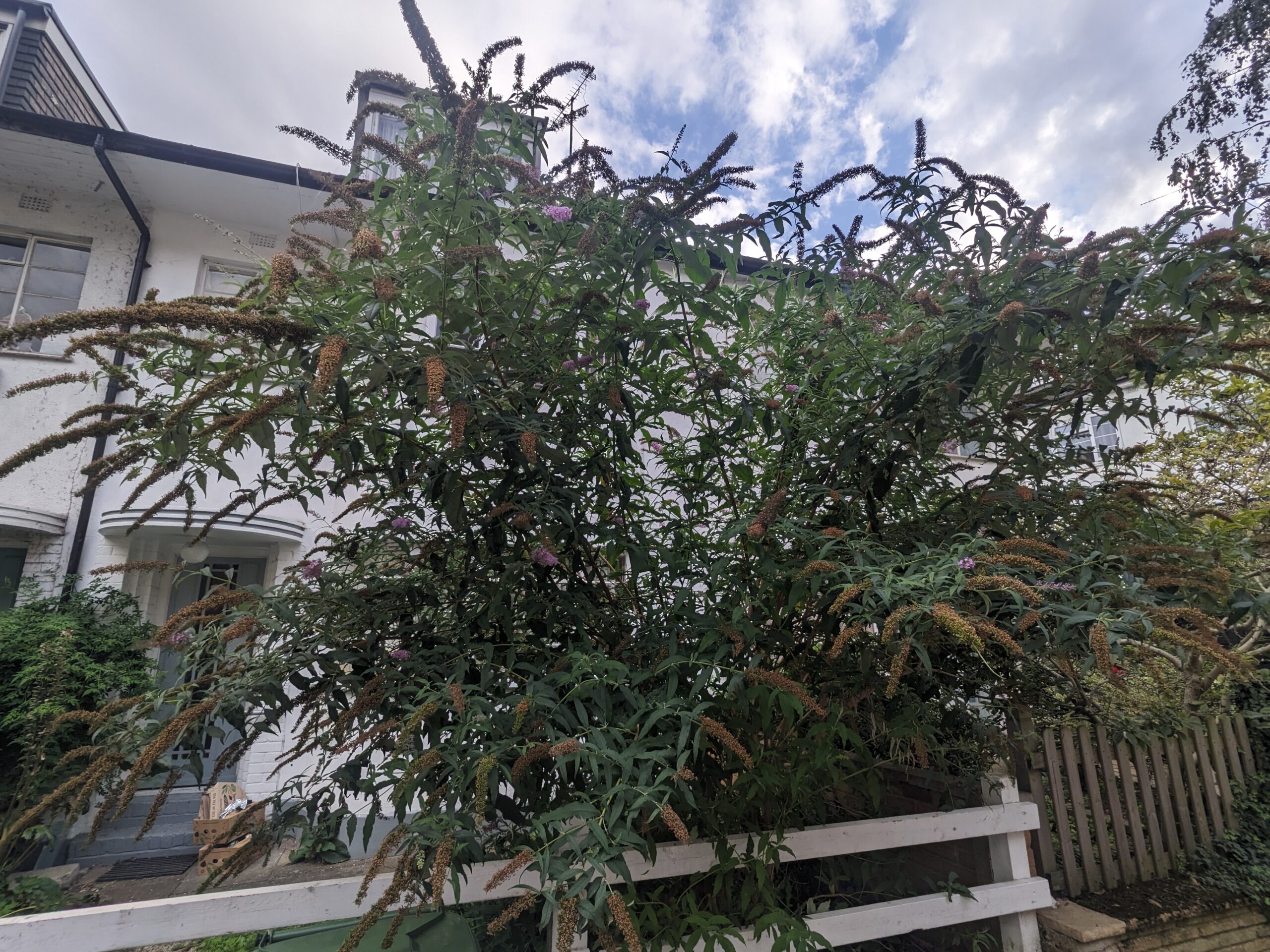
Hampstead.
Notwithstanding that it is fascinating to see situations
where, I don’t know for what reasons, these plants have grown to stupendous
scale in the gardens of London. It may be that they were planted there but I
think it’s more likely that they grew there, people thought they looked pretty,
and that they were allowed to thrive. I think if the owners knew they were
weeds (whatever your philosophy is there) they would cut them down. Leaving
aside for the moment all questions of what the right or wrong thing to do in
that situation is.
Taking the photo above two elderly women noticed me. It
turned out that this was one of their houses. They greeted me a little
quizzically. I did give a friendly hello as I scooted off on my bike, but it
was still a not entirely comfortable situation. Perfectly legal to take photos
of anything on the street of course…

Belsize Park.
Here is a huge bush in the garden of a very grand house in
Belsize Park…

Chalk Farm.
Growing out of the back of a block of flats’ shared garden…

Primrose Hill.
In the railway sidings at the back of Primrose Hill…

Islington.

Old Street.

Old Street.
Around Old Street which is the arse end of Islington –
Bunhill being the most densely populated ward in the UK apparently – I’m less
surprised to see the Buddleja being cultivated in the parks around here.
There’s a sense that no-one (least of all the council) gives a shit about the
public space.

In Croydon with its natural ally graffiti.

Croydon.

Redhill.
It is now often seen there along railway lines and on the
sites of derelict factories and other buildings. The plant frequently grew
on urban bomb sites during the aftermath of World War II, earning it the
nickname of “the bomb site plant”.
Wikipedia
entry on the Buddleja davidii.

Findhorn.
And finally even at the Findhorn Foundation, the garden of
Eden itself. Its violet flowers now dead as the season is likely to be shorter
outside Inverness.